
Patent Litigation and Generic Entry: Why Disputes Delay Life-Saving Medications
When a new brand-name drug hits the market, it comes with a patent that gives the manufacturer exclusive rights to sell it-usually for 20 years. But here’s the twist: patent litigation is now the main reason generic versions of life-saving drugs don’t reach patients for years after they’re legally allowed to. This isn’t a glitch. It’s the system working exactly as drug companies designed it-to delay competition, protect profits, and keep prices high.
How the System Was Supposed to Work
Back in 1984, Congress passed the Hatch-Waxman Act to fix a broken system. Before this law, brand-name drugmakers had a monopoly until their patent expired, and no one else could even try to make a cheaper version. Generic companies had to run full clinical trials, which took years and cost millions. The law changed that. It let generic manufacturers file an Abbreviated New Drug Application (ANDA), proving their drug was the same as the brand-name one without redoing all the testing. All they had to do was show bioequivalence. The catch? If a generic company believed a patent was invalid or not being infringed, they could file a Paragraph IV certification. This was meant to be a fast-track challenge. Once filed, the brand-name company had 45 days to sue. If they did, the FDA had to pause approval for 30 months. That was supposed to be a fair middle ground: give the brand company time to defend its patent, but not let it drag out forever.What Actually Happened
Instead of speeding up generics, the 30-month stay became a legal shield. Today, nearly 6 out of 10 first-time generic approvals face patent lawsuits. And here’s the kicker: the 30-month clock often expires years before the generic actually hits shelves. A 2021 NIH study found that the median time between the end of the 30-month stay and the actual launch was 3.2 years. That means patients are waiting nearly four years after the legal barrier is gone just to get a cheaper version of their medicine. Why? Because drugmakers don’t stop at one patent. They build patent thickets-dozens of secondary patents on things like pill coatings, dosing schedules, or delivery devices. These aren’t new inventions. They’re minor tweaks filed years after the original drug was approved. In fact, 72% of patents used in litigation were filed after the FDA approved the brand drug. These patents are often weak, but they trigger new 30-month stays every time a generic challenges one.The Cost of Delay
The numbers don’t lie. In 2023 alone, the FDA approved 90 new generic drugs. But many sat on shelves, waiting. Take Humira, the top-selling drug in U.S. history. When its main patent expired in 2023, it still took over a year for generics to launch because of layered lawsuits. The Business Group on Health estimated that just this one delay cost large employers $1.2 billion in 2023. Patients feel it too. A primary care doctor in Chicago told STAT News about patients rationing insulin because the generic was approved but blocked by litigation. One Reddit user wrote: “My patient couldn’t afford the $1,200/month brand drug. The generic was approved. But they had to wait two more years.” For generic manufacturers, it’s a gamble. Launching “at risk”-selling the drug before the court rules-can cost millions if they lose. Defending a patent case through trial averages $3-5 million. An appeal? Over $10 million. Only big companies like Teva and Sandoz can afford this. Smaller generics often give up. Teva’s 2023 annual report admitted that patent delays cost them $850 million in lost revenue.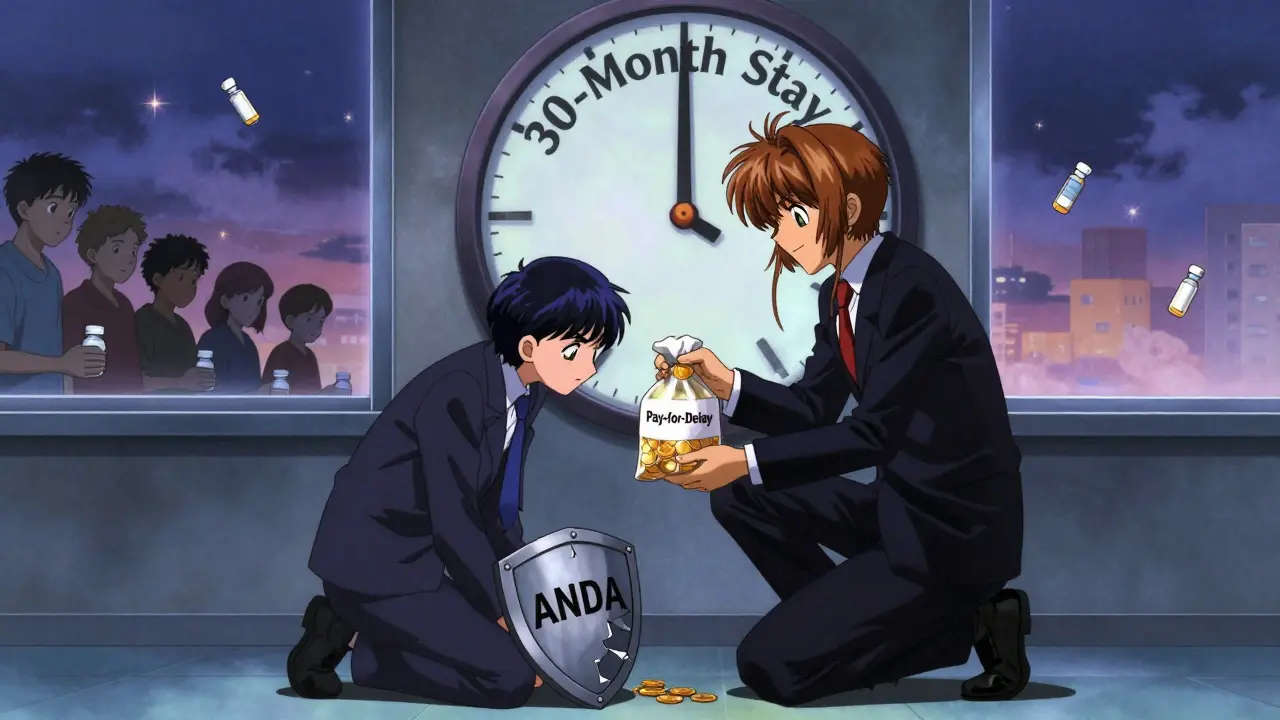
Pay-for-Delay and Other Tricks
It gets worse. Sometimes, brand-name companies don’t even fight in court. They pay the generic manufacturer to stay away. These are called pay-for-delay deals. The FTC calls them anticompetitive. In 2010, they found that even though only 24% of cases involved these payments, they accounted for nearly half of all generic delays. Other tactics include:- Restricting access to drug samples so generics can’t test against the real product
- Filing baseless petitions with the FDA to stall approval
- Using patents that were approved based on incomplete or misleading data
Why This Isn’t Fixing Itself
The FDA’s Orange Book, which lists patents for each drug, is supposed to be a roadmap for generics. But 15% of its entries are wrong. Some patents are listed that shouldn’t be. Others are missing. That creates confusion. Generic companies spend months trying to figure out which patents are real threats. Pharmacy benefit managers (PBMs) like Express Scripts now build 24-36 month delay windows into their forecasts. They know: just because a generic is approved doesn’t mean it’s available. And while the FTC has challenged over 100 patents in 2023, and Congress passed the CREATES Act to stop sample restrictions, these are small fixes. The core problem-serial litigation-remains untouched.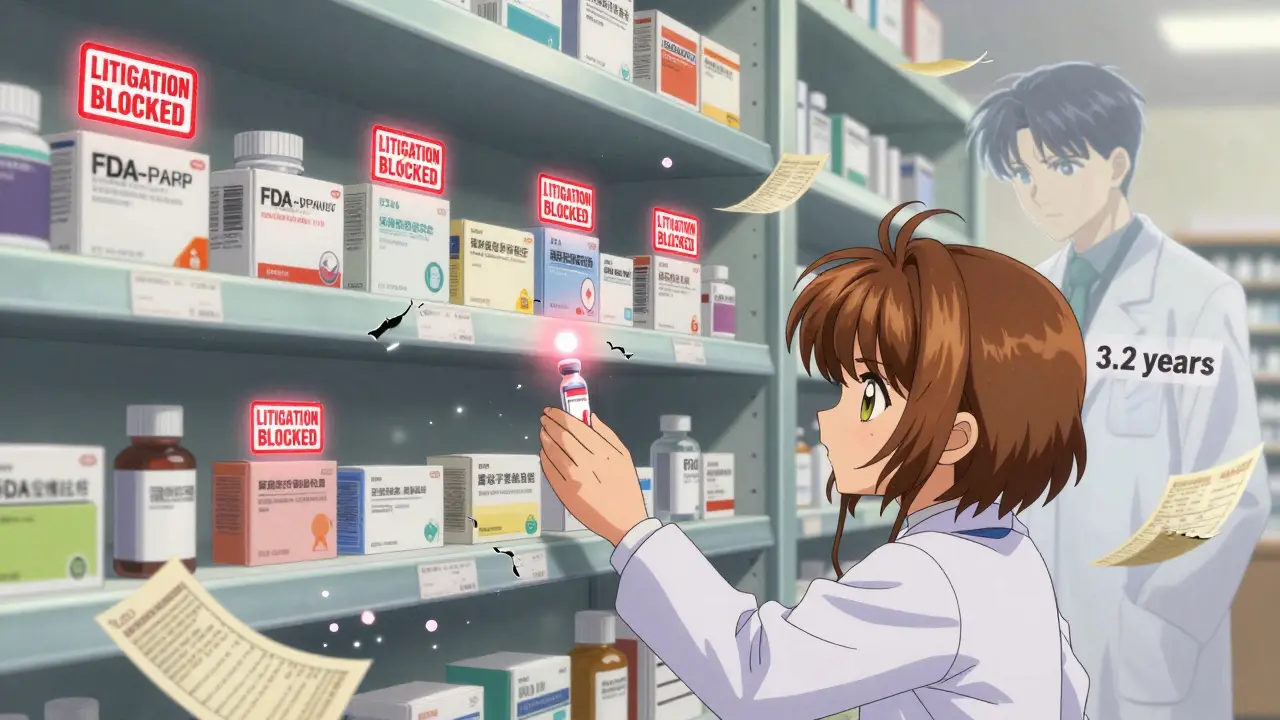
What’s Next?
Biosimilars, the biologic version of generics, are facing even longer delays. Their patent fights take 25% longer than those for regular pills. With biologics now making up 40% of drug spending, this is a growing crisis. Experts agree: without real reform, the system will keep costing patients $15-20 billion a year. The average delay per drug? 3.2 years. That’s not a coincidence. It’s by design.What Can Be Done?
Some solutions are already on the table:- Limit how many patents can be listed in the Orange Book
- End automatic 30-month stays for secondary patents
- Ban pay-for-delay agreements outright
- Require patent holders to prove their patents are valid before triggering a stay
Real Impact, Real People
This isn’t about corporate profits. It’s about people. Diabetics choosing between insulin and rent. Cancer patients skipping doses because they can’t afford the brand. Parents rationing asthma inhalers. The Hatch-Waxman Act was supposed to bring down prices and save lives. Instead, patent litigation turned it into a legal maze that only the rich and the powerful can navigate. The system is broken. And it’s costing more than money-it’s costing time. And sometimes, life.

Liam Crean
It's wild how the system was designed to help, but now it's just a loophole factory. I used to think patents were about innovation-turns out they're about delaying competition with legal gymnastics. The 30-month stay was supposed to be a buffer, not a decades-long shield.
And those patent thickets? They're not inventions. They're paperwork traps. A new coating on a pill? A different dosing schedule? That's not innovation-that's trolling the system.
Patients aren't asking for free medicine. They're asking for access. I have a friend on insulin. She rationed doses last year because the generic was approved but stuck in litigation. That's not a business problem. That's a moral one.
Ellen Spiers
It is evident that the structural incentives embedded within the Hatch-Waxman framework have been systematically subverted by strategic patent aggregation. The 30-month stay, originally conceived as a provisional equitable mechanism, has been weaponized into a de facto market exclusivity extension, thereby contravening the statutory intent of promoting generic competition.
Furthermore, the proliferation of secondary patents-often filed post-FDA approval and lacking substantive novelty-constitutes a form of regulatory arbitrage. The Orange Book’s inaccuracies, at 15%, further compound this dysfunction, rendering the legal landscape opaque and prohibitively costly for smaller manufacturers.
Pay-for-delay agreements, while explicitly anticompetitive under FTC jurisprudence, persist due to insufficient enforcement mechanisms and judicial deference to patent validity presumptions. A structural overhaul, not piecemeal reform, is requisite.
Marie Crick
This isn’t about patents. It’s about greed.
Jonathan Rutter
You guys are missing the real issue here. It’s not the patents-it’s the FDA. They’re the ones who approve these generics without even checking if they’re safe. I know a guy who works at a compounding pharmacy in Ohio, and he told me that 40% of the generics that hit the market are just repackaged junk. They don’t even test them properly.
And don’t get me started on Teva. They’re not some underdog. They’re a billion-dollar company that files lawsuits just to scare off smaller players. They’ve got lawyers on retainer for every state. Meanwhile, the real victims are the small clinics that can’t afford to buy brand-name drugs, but also can’t trust the generics because the FDA lets them slide through.
And then there’s the whole thing with PBMs. They’re the ones who control the distribution. They’re the ones who delay the generics on purpose so they can charge more. You think it’s Big Pharma? Nah. It’s the middlemen. The whole system is rigged from the top down. No one’s talking about that.
And what about the doctors? They’re pressured to prescribe the brand because the reps give them free lunches and trips. I’ve seen it. My uncle’s a cardiologist. He told me he got a free cruise last year just for prescribing one drug. That’s not a coincidence. That’s corruption.
And now Congress is introducing bills? Please. They get campaign donations from these companies. They’re not going to bite the hand that feeds them. The only solution? Burn the whole system down and start over. No more patents. No more FDA. No more PBMs. Just let the market decide. Let people buy directly from manufacturers. Let generics be sold without approval. It’s the only way.
And don’t tell me that’s dangerous. People have been buying medicine online for years. You think they’re all dying? No. They’re saving money. And if a few get sick? So what? The system is already killing more people by delaying access. You’re scared of a little risk? Then you’re part of the problem.
Ashley Paashuis
Thank you for laying this out so clearly. It’s easy to feel helpless when the system feels rigged, but understanding the mechanics-like how patent thickets work, or how the Orange Book is unreliable-gives us a starting point for advocacy.
It’s also worth noting that the CREATES Act, while limited, was a step in the right direction. It at least addresses sample access, which is a concrete barrier. But yes, the real fix requires structural change: ending automatic stays for secondary patents, banning pay-for-delay, and holding patent offices accountable for inaccurate listings.
Patients aren’t asking for handouts. They’re asking for fairness. And fairness means letting competition do what it’s supposed to do: lower prices and increase access.
Oana Iordachescu
Let me ask you this: what if the entire pharmaceutical industry is a controlled experiment? Think about it. The FDA, the patent office, Congress-they’re all connected. Same lobbyists. Same revolving doors. What if the delays aren’t accidents? What if they’re intentional? To keep people dependent? To create a market for lifelong medication?
I’ve seen the numbers. Cancer survival rates have gone up… but only for people who can afford the drugs. The rest? They’re dying quietly. And the media doesn’t report it. Why? Because the advertisers are the same companies causing the problem.
There’s a reason why insulin costs $1,200 in the U.S. and $12 in Canada. It’s not manufacturing. It’s control. And I’m not paranoid. I’m informed.
Davis teo
I just read this whole thing and I’m furious. I’m so angry I can’t even sit still.
My mom died because she couldn’t afford her chemo. The generic was approved. It was ready. But the company sued. For 2 years. Two years. She didn’t even make it to the third.
And now you want to talk about ‘reform’? You want to talk about ‘bills’? I don’t want bills. I want blood. I want these CEOs in handcuffs. I want their houses seized. I want their kids to know what it’s like to choose between rent and medicine.
Stop talking. Start burning.
Michaela Jorstad
I appreciate the depth of this post. It’s rare to see such a clear breakdown of how patent litigation is being weaponized against patients.
I’ve worked in pharmacy for over 15 years, and I’ve seen firsthand how generics sit on shelves for months-even years-after approval. The frustration isn’t just financial; it’s emotional. Patients cry when they find out their medication isn’t available. They ask, ‘Why?’ And we have no good answer.
The fact that 72% of litigation patents were filed after FDA approval? That’s not innovation. That’s manipulation. And the Orange Book errors? They’re not just ‘mistakes’-they’re negligence.
I’m hopeful that the Protecting Consumer Access to Generic Drugs Act gains traction. But we need more than legislation. We need public pressure. We need patients to speak up. We need pharmacists to refuse to stay silent.
Thank you for giving us the facts. Now, let’s use them.
Chris Beeley
Look, you’re all missing the elephant in the room. This isn’t about patents. This isn’t about Congress. This is about the fundamental flaw in Western capitalism: the assumption that innovation must be monetized through monopoly. That’s not capitalism. That’s feudalism with lawyers.
The patent system was never meant to be a tool for corporate entrenchment. It was meant to incentivize discovery by granting temporary exclusivity. But now, companies don’t invent-they litigate. They don’t innovate-they file. They don’t cure-they delay.
And the real tragedy? We’ve normalized it. We accept that a cancer drug should cost $10,000 a month because ‘it’s R&D.’ But R&D doesn’t cost $10,000 a month. It costs $2 million. And it’s funded by public grants. The public pays for the science. Then the company charges the public again for the product. That’s not a market. That’s a robbery.
So let’s stop pretending this is a policy issue. It’s a moral crisis. And until we stop treating medicine like a luxury good, we’re all complicit.
And yes-I’m saying this as someone who’s read every law, every study, every FTC report. I’m not angry. I’m just disappointed. We had the tools. We just chose not to use them.
Arshdeep Singh
Bro, this whole thing is just proof that capitalism is a pyramid scheme. You think the patent system was made to help people? Nah. It was made to help the rich get richer. And now we’re all stuck paying for it.
I’m from India. We get generics for pennies. Like, insulin here costs like $3. In the US? $1,200. Same pill. Same science. But one country treats medicine like a human right. The other treats it like a stock option.
And don’t even get me started on pay-for-delay. That’s not business. That’s bribery. And they call it ‘legal.’
Real talk: if you can’t afford medicine, you’re not poor. You’re targeted. The system was designed to leave you behind. And now you’re surprised? Wake up.
Stop asking for reform. Start asking for revolution. The system isn’t broken. It’s working perfectly-for them.