
FDA Orange Book: How Approved Generic Drugs Are Listed and Why It Matters
The FDA Orange Book is the go-to source for knowing which generic drugs are officially approved and can be swapped for brand-name medications in the U.S. It’s not just a list-it’s the rulebook that tells pharmacists, doctors, and insurers which generics are safe to substitute. If you’ve ever picked up a cheaper pill and wondered if it’s truly the same as the brand, the Orange Book is why you can trust that swap.
What Exactly Is the FDA Orange Book?
The official name is Approved Drug Products With Therapeutic Equivalence Evaluations. It’s been around since 1984, created under the Hatch-Waxman Act to balance two goals: letting generic drugs enter the market quickly and protecting the patents of brand-name companies. The FDA’s Center for Drug Evaluation and Research (CDER) updates it every month. As of late 2023, it lists over 16,000 approved drugs-both prescription and over-the-counter.
It’s called the "Orange Book" because of its original cover color. Today, it’s digital, free, and searchable online. You won’t find it on pharmacy shelves, but you’ll find its data inside pharmacy systems, insurance databases, and hospital software. Without it, generic drug substitution would be a guessing game.
How Generic Drugs Get Listed
Generic drugs don’t go through the same long, expensive trials as brand-name drugs. Instead, they use the Abbreviated New Drug Application (ANDA) pathway. To get approved, a generic maker must prove one thing: bioequivalence. That means their version delivers the same amount of active ingredient into the bloodstream at the same rate as the original.
But here’s the key: they have to compare their drug to a specific brand-name product. That product is called the Reference Listed Drug (RLD). The RLD is the gold standard. In the Orange Book, every generic is marked as "No" in the RLD column, while the original brand is marked "Yes." You can’t list a generic without naming the RLD it’s copying.
For example, if you search for "atorvastatin," you’ll see Lipitor (the brand) listed as the RLD. Then you’ll see dozens of generics-Teva, Mylan, Sandoz-all linked to that same RLD. Each one is approved because it matches Lipitor’s performance in the body.
Therapeutic Equivalence (TE) Codes: The Secret Code
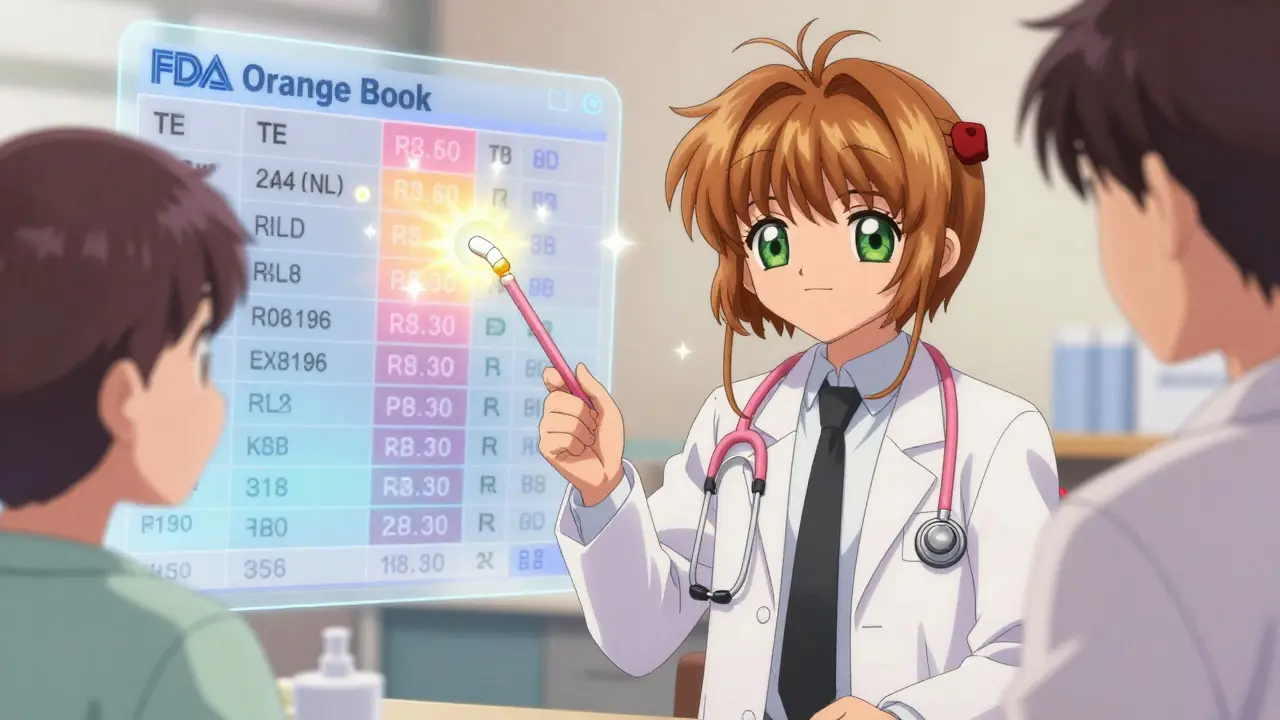
Not all generics are treated the same. The Orange Book assigns each drug a Therapeutic Equivalence (TE) Code. These two-letter codes tell you whether a generic can be automatically swapped by a pharmacist without a doctor’s approval.
- A codes mean the drug is therapeutically equivalent. Pharmacists can substitute these freely.
- B codes mean there’s uncertainty. Maybe the drug has a complex delivery system, like an inhaler or a gel, where small differences matter. These aren’t automatically interchangeable.
- BN codes mean it’s the only product available for that drug. No generics exist yet.
These codes aren’t just labels-they directly affect what you pay. If a drug has an "A" code, insurers will push the cheapest generic. If it’s "B," you might get stuck with the brand or pay more for a specific generic.
Authorized Generics: The Hidden Option
There’s another kind of generic you won’t find in the Orange Book: the authorized generic. This is the exact same drug as the brand, made by the same company, but sold without the brand name. Think of it as the brand selling its own product under a different label.
For example, when the brand-name drug Adderall XR was first approved, its maker also launched an authorized generic-same pills, same packaging, same manufacturer, just no "Adderall" on the bottle. It’s cheaper than the brand but identical in every way.
These aren’t listed in the Orange Book because they’re approved under the original brand’s New Drug Application (NDA), not an ANDA. Instead, the FDA keeps a separate, quarterly updated list of authorized generics on its website. If you’re looking for the closest thing to the brand at a lower price, check both the Orange Book and the authorized generics list.
Patents and Exclusivity: The Roadblocks
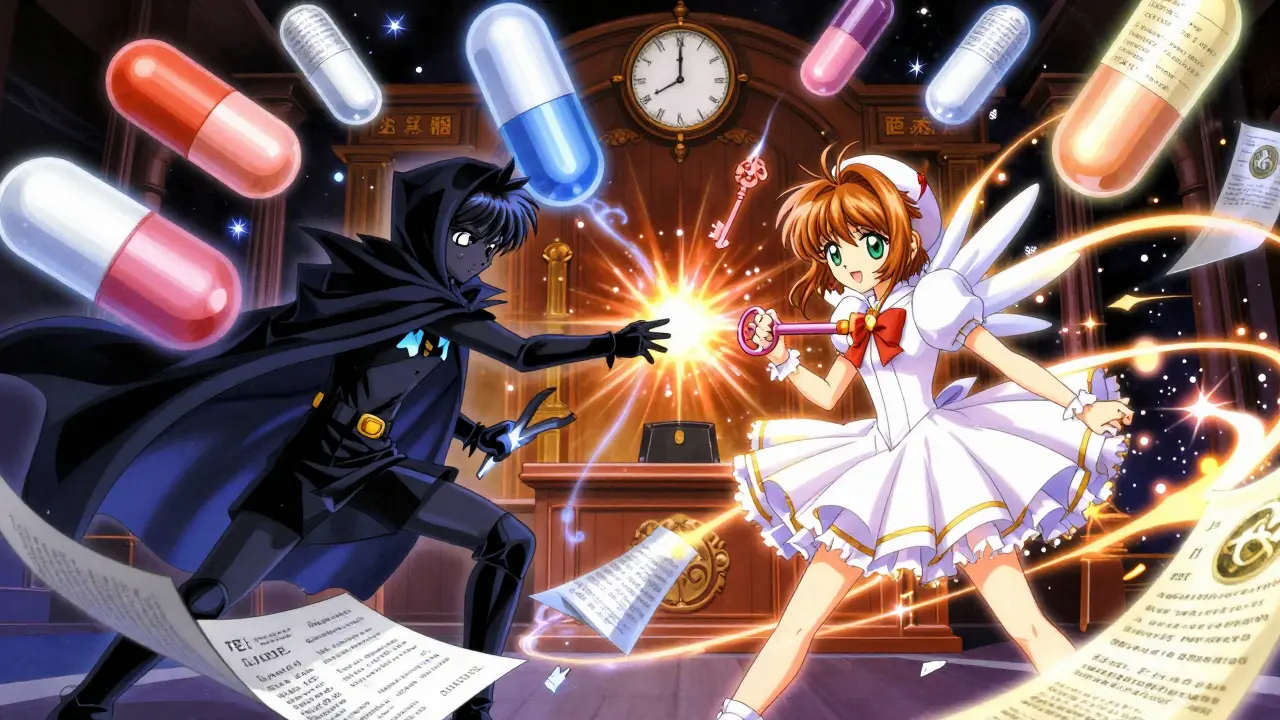
The Orange Book doesn’t just list drugs-it lists patents. When a brand-name company gets approval, it must tell the FDA which patents cover the drug. These include patents on the active ingredient, the pill’s shape, or how it’s used.
Each patent gets a unique code, like "U-123," and an expiration date. Generic makers must wait until those patents expire-or challenge them in court-before they can launch. This is where the 30-month legal hold comes in. If a generic company files an ANDA and says a patent is invalid, the brand can sue. That triggers a 30-month pause on generic approval, even if the patent is later thrown out.
There’s criticism here. From 2005 to 2022, the number of patents listed in the Orange Book jumped from 8,000 to over 14,000. Critics say some companies file dozens of weak patents just to delay generics-a tactic called "patent evergreening." The FDA says it’s cracking down, and in 2023 it tightened rules to stop listing patents that don’t clearly cover the drug’s approved use.
How to Use the Electronic Orange Book
The online version is free and easy to use. Here’s how to find what you need:
- Go to the FDA’s Electronic Orange Book website.
- Search by active ingredient (like "metformin") or brand name (like "Glucophage").
- Look for the RLD. It’s marked clearly.
- Below it, you’ll see all approved generics with their TE codes.
- Check the "Discontinued" section if you’re wondering why a generic disappeared.
Pro tip: Use the "Ingredient Search" if you’re unsure of the brand name. For combo drugs like Trelegy Ellipta (which has three ingredients), you need to search all three separately to see what’s available.
Why This Matters to You
If you take a generic drug, the Orange Book is why it works. If you’re a pharmacist, it’s why you can swap pills without risking patient safety. If you’re on insurance, it’s why your co-pay is lower.
But it’s not perfect. Pharmacists report confusion with complex drugs-like inhalers or eye drops-where TE codes don’t always match real-world results. Some states have laws that override the Orange Book’s recommendations. One study found 62% of pharmacy staff had experienced a case where the Orange Book listing didn’t match what their state allowed.
And for patients, it means knowing what you’re getting. If your prescription says "atorvastatin" and you get a different generic next month, check the TE code. If it’s still "A," you’re fine. If it’s "B," ask your pharmacist why.
The Bigger Picture
The U.S. generic drug market is worth over $67 billion. Ninety percent of prescriptions are filled with generics. That’s possible because of the Orange Book. It’s the invisible system that lets competition work in a heavily regulated industry.
But change is coming. The FDA is building a new "Digital Orange Book" by 2025, with real-time updates and better data for complex drugs. The API now handles over 2 million searches a month-from pharmacy chains, insurers, and even AI-driven prescribing tools.
The goal? Faster access, clearer data, and fewer barriers. The Orange Book isn’t just a list. It’s the backbone of affordable medicine in America.
Is the FDA Orange Book the same as Drugs@FDA?
No. Drugs@FDA shows all drug applications-approved, pending, or rejected. The Orange Book only lists approved drugs with therapeutic equivalence ratings. If a generic is still under review, you’ll see it on Drugs@FDA but not in the Orange Book.
Can I trust all generics listed in the Orange Book?
Yes-if they have an "A" code. The FDA requires strict bioequivalence testing. But "B" codes mean there’s uncertainty, often due to complex delivery systems. Don’t assume all generics behave the same. Always check the TE code.
Why do some generics cost more than others even if they’re the same drug?
Price isn’t determined by the Orange Book. It’s set by manufacturers and insurers. Even if two generics have the same TE code, one might be priced higher due to supply, distribution, or agreements with pharmacy benefit managers. The Orange Book only says they’re equivalent-not that they cost the same.
Are over-the-counter (OTC) drugs listed in the Orange Book?
Yes, they’re listed-but they’re not evaluated for therapeutic equivalence. The FDA doesn’t assign TE codes to OTC drugs because they’re not typically substituted like prescriptions. You’ll see them in the OTC section, but you can’t use the Orange Book to swap one OTC product for another.
What happens if a drug is removed from the Orange Book?
If a drug is discontinued, it moves to the Discontinued Drug Product List. That means it’s no longer available in the U.S. market. It could be due to safety issues, low demand, or manufacturing problems. Once it’s moved there, it’s no longer eligible for substitution.

JUNE OHM
So the gov't lets Big Pharma game the system with patent crap? 😤 I'm not taking some cheap generic that might as well be chalk dust. 🚫💊 #AmericaFirst
Philip Leth
yo i just picked up my metformin last week and it looked totally different than last month. turned out it was a new generic with an A code. no big deal. my sugar's still chill. 🤷♂️
Vincent Sunio
The notion that therapeutic equivalence can be meaningfully reduced to a two-letter code is not merely reductive-it is epistemologically unsound. The pharmacokinetic variance between manufacturers, even within the bounds of bioequivalence, remains inadequately captured by the FDA’s current framework. One cannot reduce complex biopharmaceutical equivalence to a bureaucratic checkbox.
Angela Goree
TE codes? lol i thought they were like pizza ratings. A=good, B=eh, BN=you're screwed. 🤦♀️
veronica guillen giles
Oh sweetie, you think the Orange Book is the bible? Honey, I’ve seen pharmacists swap A-coded drugs and patients end up in the ER. The system’s a glitchy Excel sheet with a fancy name.
Sarah Little
The absence of real-time pharmacovigilance data integration in the current iteration of the Electronic Orange Book represents a significant systemic gap in post-market surveillance for bioequivalent therapeutics. This is a critical vulnerability.
erica yabut
Let’s be honest: the FDA is just a corporate lapdog with a white coat. They let pharma bury patents like buried treasure-and then call it ‘innovation.’ Meanwhile, you’re paying $12 for a pill that costs 17 cents to make. Pathetic.
innocent massawe
I'm from Nigeria, and we don't have anything like this. We just take what's available. Sometimes it works, sometimes it doesn't. I'm glad you have a system, even if it's messy. 🙏
Tru Vista
authorized generics aren't even listed? that's just dumb. fix it already.