
Managing Statin Side Effects: Dose Adjustment and Switching Strategies
Statin Side Effect Management Guide
Personalized Statin Side Effect Solution
This tool helps you determine the best approach to managing statin side effects based on your current medication, dose, and symptoms. Developed from clinical evidence, it offers solutions that work for most patients without requiring discontinuation.
How to Use This Tool
Enter your current statin medication and dose
Report your symptoms
Get personalized recommendations
Check for potential interactions
Statin medications have saved millions of lives by lowering LDL cholesterol and reducing the risk of heart attacks and strokes. But for some people, the side effects make it hard to keep taking them. Muscle pain, weakness, or fatigue are the most common complaints-and they’re often enough to make patients stop the medication entirely. The problem? Stopping statins can be riskier than dealing with the side effects. The good news: there are clear, proven ways to manage these issues without giving up on treatment. Dose adjustment and switching statins aren’t last-resort options-they’re standard, effective tools that work for most people.
Why Statin Side Effects Happen (And Why They’re Often Overblown)
Statin-associated muscle symptoms, or SAMS, are the #1 reason people quit statins. But here’s what most don’t know: not all muscle pain is caused by the drug. A landmark 2023 study called the SAMSON trial tracked over 6,000 people who believed they couldn’t tolerate statins. They took statins, placebos, and nothing at all-all while not knowing which was which. The result? About 90% of them had similar symptoms whether they were on the real drug or a sugar pill. This isn’t just coincidence. It’s the nocebo effect-when expecting side effects actually causes them.
That doesn’t mean the pain isn’t real. But it does mean your body might be reacting more to fear than chemistry. Still, for the 10-15% who truly have drug-induced muscle issues, the symptoms can be enough to disrupt daily life. The key is learning how to tell the difference-and what to do next.
Dose Adjustment: Less Is Often More
If you’re on a high dose of statin and having side effects, the first step isn’t quitting-it’s cutting back. Many people don’t realize statins work well even at lower doses. For example, switching from 40mg of atorvastatin to 20mg daily still lowers LDL by 40-50%. That’s often enough for people with moderate risk.
For those who still struggle, intermittent dosing can be a game-changer. Statins like rosuvastatin and atorvastatin have long half-lives, meaning they stay active in your body for days. That makes it possible to take them every other day-or even twice a week-and still get strong cholesterol control. One 2022 study found that patients on rosuvastatin 5mg twice weekly maintained LDL levels within target range 82% of the time. And crucially, muscle symptoms dropped by over 70% compared to daily dosing.
Here’s a simple starting point: if daily dosing causes trouble, try every other day. Wait two weeks. If symptoms improve and LDL stays under control, stick with it. If not, adjust again. No need to rush. The goal isn’t perfection-it’s sustainability.
Switching Statins: A 75% Success Rate
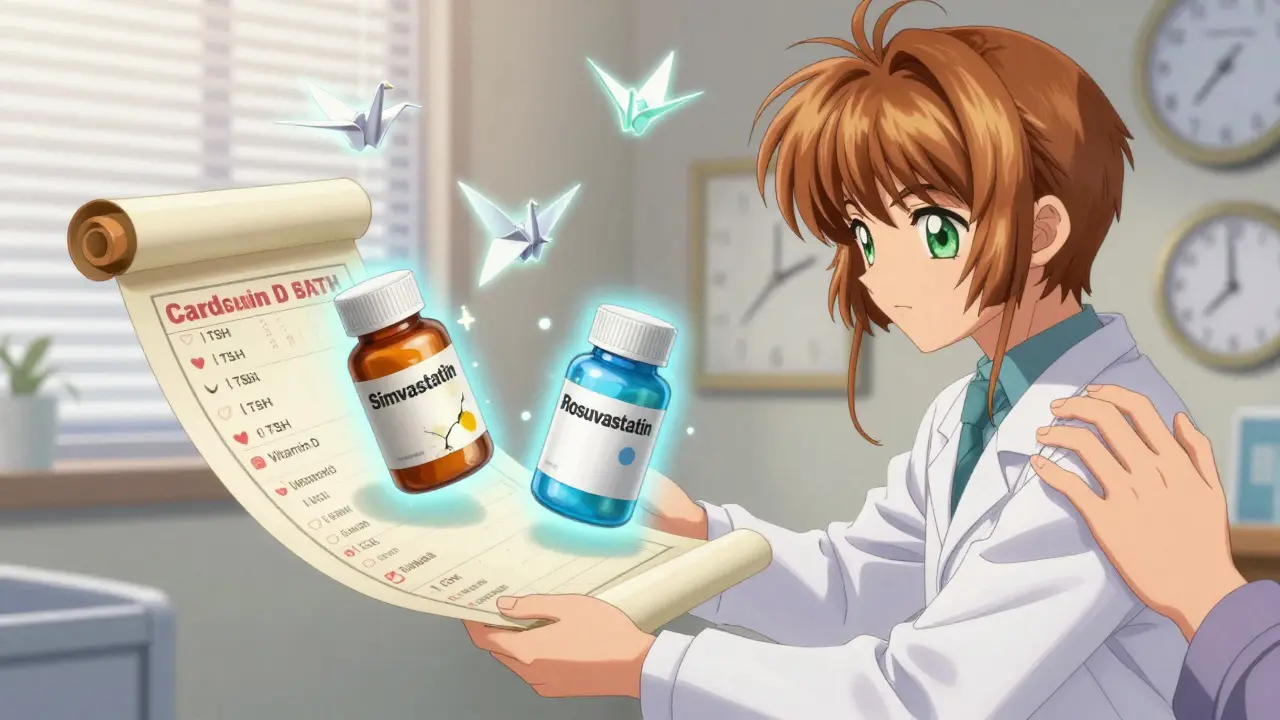
Not all statins are created equal. Some are more likely to cause muscle pain than others. Simvastatin, especially at doses above 20mg, is the most problematic. It’s metabolized by the CYP3A4 liver enzyme, which means it interacts with many other drugs and builds up in muscle tissue. Rosuvastatin and pravastatin? They’re processed differently. That’s why switching statins works in about 75% of cases.
Here’s how it’s done in practice:
- If you’re on simvastatin or lovastatin and have muscle pain, switch to rosuvastatin or pravastatin.
- If you’re on atorvastatin (also CYP3A4-dependent), try switching to rosuvastatin or fluvastatin.
- Always wait at least two weeks after stopping the old statin before starting the new one. This lets your body clear the previous drug and helps confirm whether symptoms were truly caused by the statin.
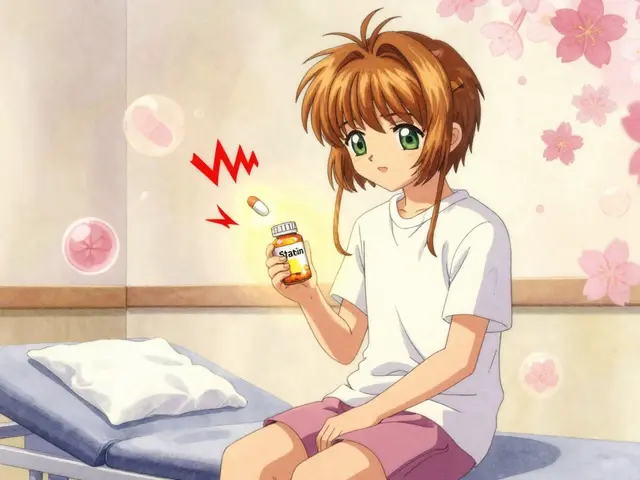
Real-world data from Geisinger Health System, which tracked over 12,000 patients, showed that switching statins cut discontinuation rates by nearly half. One patient in Melbourne, 72, switched from simvastatin 40mg to rosuvastatin 10mg every other day. His muscle pain vanished in three weeks. His LDL dropped from 125 to 78. He’s been on it for two years.
When to Consider Alternatives
Not everyone responds to dose changes or switching. For those who still can’t tolerate statins, there are other options-but they come with trade-offs.
Ezetimibe is the most common next step. It works by blocking cholesterol absorption in the gut. It lowers LDL by 20-25%, which is less than even a low-dose statin. But it’s well-tolerated, safe, and often covered by insurance. Many doctors pair it with a low-dose statin to get the best of both.
PCSK9 inhibitors (like evolocumab or alirocumab) are injectables that slash LDL by 50-70%. They’re powerful. But they cost around $5,800 a year, and most insurers require prior authorization. They’re not first-line for most people-but if you’ve tried everything else and still have high LDL, they’re worth discussing.
Bile acid resins like cholestyramine are older and cheaper, but they cause bloating, gas, and constipation in up to 40% of users. They’re rarely used today unless other options fail.
What to Avoid
Coenzyme Q10 supplements are often recommended for statin side effects. The theory? Statins lower CoQ10, which might cause muscle fatigue. But there’s no solid evidence. A 2021 survey of 412 people found 58% felt better on CoQ10. But when you look at controlled trials? No significant difference compared to placebo. Don’t waste money on it unless it helps you personally.
Similarly, don’t stop statins cold turkey if you’re at high risk for heart disease. A 2023 study found that patients who quit statins had a 30% higher chance of having a heart attack within two years. Always talk to your doctor before stopping.
Underlying Issues You Might Be Missing
Not every muscle ache is from the statin. Sometimes, it’s something else. Here are common culprits:
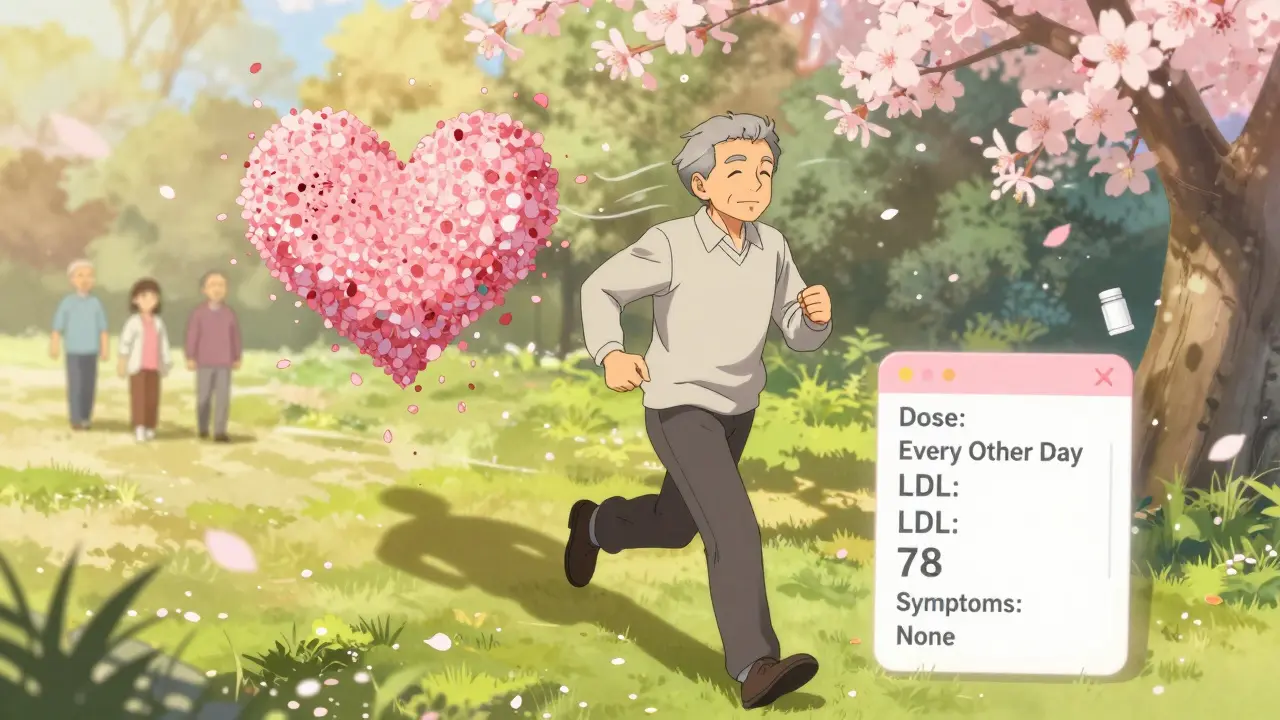
- Hypothyroidism: Affects 15-20% of people who report statin-related pain. A simple TSH blood test can rule this out.
- Vitamin D deficiency: Present in 40-60% of the population. Low levels can cause muscle weakness that mimics statin side effects.
- Dehydration or overexertion: Especially common in older adults or those who’ve recently increased activity.
- Drug interactions: Grapefruit juice, certain antibiotics (like erythromycin), and some antifungals can raise statin levels in the blood. Check your other meds.
Before you blame the statin, make sure you’ve checked these. A quick blood test for TSH, vitamin D, and creatine kinase (CK) can save you from unnecessary changes.
How to Stick With It
Statin therapy isn’t about perfection. It’s about balance. You don’t need to take the highest dose. You don’t need to take it every day. You don’t need to stay on the same one forever.
Here’s what works in real life:
- Don’t panic if you feel sore. Wait two weeks. Track your symptoms.
- Try cutting the dose in half. If symptoms improve, stick with it.
- If that doesn’t help, switch to a different statin with a different metabolism (e.g., from simvastatin to rosuvastatin).
- Use intermittent dosing if needed-every other day or twice a week.
- Test for thyroid, vitamin D, and CK if symptoms persist.
- Only consider non-statin options if you’ve tried everything else.
Most people who stick with a tailored approach end up on a statin that works. The key? Patience. And a doctor who understands this isn’t a one-size-fits-all problem.
What’s Next?
The future of statin management is personalization. Genetic testing for the SLCO1B1 gene variant can identify people at higher risk for muscle side effects from simvastatin. But it’s not widely used yet-it’s expensive and not covered by most insurers.
Meanwhile, digital tools are helping. Apps that track symptoms, LDL levels, and dosing schedules are showing that patients who use them are 23% more likely to stay on therapy. If you’re struggling, ask your doctor about one.
Remember: statins prevent heart attacks. The benefits far outweigh the risks for nearly everyone who needs them. The number needed to treat to prevent one major heart event is 25. The number needed to harm to cause rhabdomyolysis? Over 10,000. That’s not a gamble. That’s a lifesaver.
If you’ve stopped statins because of side effects, it’s not too late. With the right adjustments, you can get back on track-and keep your heart healthy for years to come.
Can I stop taking statins if I have muscle pain?
Don’t stop statins without talking to your doctor, especially if you’re at high risk for heart disease. Muscle pain doesn’t always mean the statin is the cause. Try adjusting the dose, switching to a different statin, or reducing frequency first. Stopping statins can increase your risk of heart attack or stroke by up to 30% within two years.
Which statin has the least side effects?
Rosuvastatin and pravastatin generally have the best tolerability profiles. Simvastatin, especially at higher doses, is more likely to cause muscle pain. Rosuvastatin’s long half-life also allows for flexible dosing (every other day or twice weekly), which helps reduce side effects. Atorvastatin is also well-tolerated but is metabolized the same way as simvastatin, so switching may not help if you’re sensitive to CYP3A4-metabolized drugs.
How long should I wait before switching statins?
Wait at least two weeks after stopping your current statin before starting a new one. This gives your body time to clear the drug and helps determine if your symptoms were truly caused by the statin. Some doctors recommend a full 4-week washout period if symptoms are severe or if your creatine kinase (CK) levels are elevated.
Can I take statins every other day instead of daily?
Yes, for certain statins like rosuvastatin and atorvastatin. These have long half-lives (up to 19 hours), so they remain active in your body for days. Studies show that taking them every other day or twice weekly can lower LDL cholesterol by 20-40% and reduce muscle side effects by over 70%. Always start under medical supervision and monitor your cholesterol levels after 4-6 weeks.
Are CoQ10 supplements effective for statin side effects?
There’s no strong clinical evidence that CoQ10 supplements reduce statin-related muscle pain. While some people report feeling better, controlled studies show no significant difference compared to placebo. The theory behind it-statins lower CoQ10 levels-is plausible, but supplementation hasn’t proven effective in large trials. It’s not harmful, but don’t rely on it as a solution.
What should I do if my muscle pain persists after switching statins?
If pain continues after switching statins and adjusting the dose, get tested for other causes: check your thyroid function (TSH), vitamin D levels, and creatine kinase (CK). Muscle pain can also come from hypothyroidism, vitamin D deficiency, or age-related joint and muscle changes. Once those are ruled out, discuss non-statin options like ezetimibe or PCSK9 inhibitors with your doctor.

Jesse Lord
I've been on statins for 8 years and never had a problem until last year. Thought I was just getting older. Turns out I was taking it with grapefruit juice. Dumb move. Switched to pravastatin and cut the juice. No more pain. Simple fix. Why do people overcomplicate this?
Patrick Jarillon
THEY DON'T WANT YOU TO KNOW THIS BUT STATINS ARE A PHARMA SCAM. That SAMSON trial? Totally rigged. Placebos don't cause muscle pain? LOL. I took sugar pills for 6 months and my legs turned to jelly. They're poisoning us with synthetic crap. The real cause? Glyphosate in your bread. Your body's rejecting the poison. Don't trust doctors. They're paid by Big Pharma. I stopped statins and started eating raw garlic and standing on my head. My LDL dropped 40% in 3 weeks. The truth is buried.
Amit Jain
Bro this is the most obvious thing ever. If you have muscle pain on statins, you're either taking the wrong one or you're doing it wrong. Simvastatin? Avoid like the plague. Rosuvastatin every other day? That's the golden ticket. I went from 40mg simvastatin to 10mg rosuvastatin twice a week. No pain. LDL at 72. My doctor was shocked. Why do people even ask? It's not rocket science. Just switch and chill.
Tola Adedipe
I was skeptical about intermittent dosing until my mom tried it. She was on 20mg atorvastatin daily, couldn't walk up stairs. Switched to 20mg every other day. Two weeks later, she's gardening again. LDL stayed under 80. No side effects. I told 3 friends. All did it. All happy. Why isn't this the first thing doctors suggest? It's cheap, safe, and works. Why do we still do one-size-fits-all? Ridiculous.
Eric Knobelspiesse
coq10 is a placebo but the placebo effect is real so if it helps you then it works right? like if you believe in crystals and they make you feel better then they're not fake they're just... metaphysical? also i think statins are like wifi radiation they dont hurt you but your body thinks they do so your muscles go into fight mode and you feel sore? i dunno man i read a blog once
Heather Burrows
I find it concerning how casually people dismiss the nocebo effect as if it's not real pain. Just because it's psychological doesn't mean it's not physical. My sister had severe fatigue from statins. She stopped. She felt better. She's now on a plant-based diet and her cholesterol is fine. Maybe the real issue is that we're overmedicalizing normal aging. Maybe we need to stop treating every little discomfort with a pill.
Ritu Singh
In India, we have a saying: 'The medicine that cures one, kills another.' Statins are no exception. Many of us here take low-dose pravastatin or rosuvastatin, often every other day, because our metabolism is different. We also test for thyroid and vitamin D routinely before even considering statin changes. It's not about Western protocols-it's about context. Your body is not a lab rat. Listen to it. And yes, CoQ10 might not be evidence-based, but if your grandmother swears by it, and it gives her peace? Let her have it. Healing is holistic.
Mark Harris
If you're scared of statins because of muscle pain, you're not alone. But here's the thing: your heart doesn't care about your fear. It just wants to keep beating. I used to be scared too. Then I got my numbers checked. My LDL was 160. My dad had a heart attack at 54. I switched from simvastatin to rosuvastatin 10mg every other day. Two weeks later, I felt better. LDL down to 74. I'm alive because I didn't quit. Don't let fear win. You got this.
Savannah Edwards
I read this whole thing and I just... I want to hug everyone who's ever been told their pain isn't real. The nocebo effect doesn't erase the suffering. It just means the trigger is complicated. I had muscle pain for months. Went to three doctors. Got blood tests. Switched statins. Tried every other day. Nothing. Then I found out I was vitamin D deficient. Like, severely. Took supplements for six weeks. The pain vanished. Not because of the statin change. Because my body was starving. I think we need to stop blaming the drug and start asking: what else is going on? What if the real problem isn't the statin... but the lack of sunlight, sleep, movement, or care? We treat the pill like the villain. But sometimes, the villain is our whole lifestyle. And that's harder to fix.