
Warfarin and NSAIDs: Why Combining Them Raises Bleeding Risk

Warfarin & NSAID Bleeding Risk Calculator
This tool estimates your bleeding risk when combining warfarin with NSAIDs based on clinical studies. It does not replace professional medical advice.
Your Bleeding Risk Assessment
Recommendation
No recommendations yet. Calculate your risk to see what you should do.
Risk Factors Summary
Combining warfarin and NSAIDs might seem like a simple fix-take a pain reliever for your arthritis while staying on your blood thinner. But this combo isn’t just risky. It’s dangerous. And it happens more often than you think.
How Warfarin Works
Warfarin is an anticoagulant, a blood thinner that’s been used since the 1950s. It doesn’t actually thin your blood. Instead, it blocks vitamin K from doing its job in the liver. Vitamin K is essential for making clotting factors II, VII, IX, and X. Without them, your blood can’t form clots as easily. That’s good if you’re at risk for a stroke or clot, but bad if you get a cut or bruise.
Your doctor monitors this with a blood test called INR (International Normalized Ratio). A normal INR is around 1.0. For most people on warfarin, the target is between 2.0 and 3.0. If your INR goes above 4.0, your bleeding risk shoots up. And that’s where NSAIDs come in.
What NSAIDs Do to Your Body
NSAIDs-like ibuprofen, naproxen, diclofenac, and meloxicam-are common painkillers. They work by blocking enzymes called COX-1 and COX-2. COX-2 is involved in inflammation and pain. COX-1? That’s the one that protects your stomach lining and helps platelets stick together.
When NSAIDs block COX-1, two things happen:
- Your platelets can’t clump together to seal a wound. This slows down clotting.
- Your stomach loses its natural protective mucus layer. This makes ulcers and bleeding more likely.
So NSAIDs don’t just affect your joints-they mess with your body’s ability to stop bleeding anywhere. When you add that to warfarin’s effect on clotting factors, you’re stacking two different ways to increase bleeding risk. It’s not just additive. It’s multiplicative.
The Numbers Don’t Lie
A 2019 study from the European Society of Cardiology looked at over 100,000 people on anticoagulants. The results were stark:
- People taking warfarin + an NSAID had more than double the risk of bleeding compared to those on warfarin alone.
- Specific NSAIDs carried different risks: ibuprofen raised risk 1.79 times, diclofenac 3.3 times, and naproxen a shocking 4.1 times.
- Brain bleeds (intracranial hemorrhage) went up 3.22 times.
- Gastrointestinal bleeding went up 2.24 times.
- Anemia from bleeding nearly tripled.
One 2010 study of 98 patients found that almost 40% had their INR spike by 15% or more after starting an NSAID. That’s not a small change. That’s a medical emergency waiting to happen.
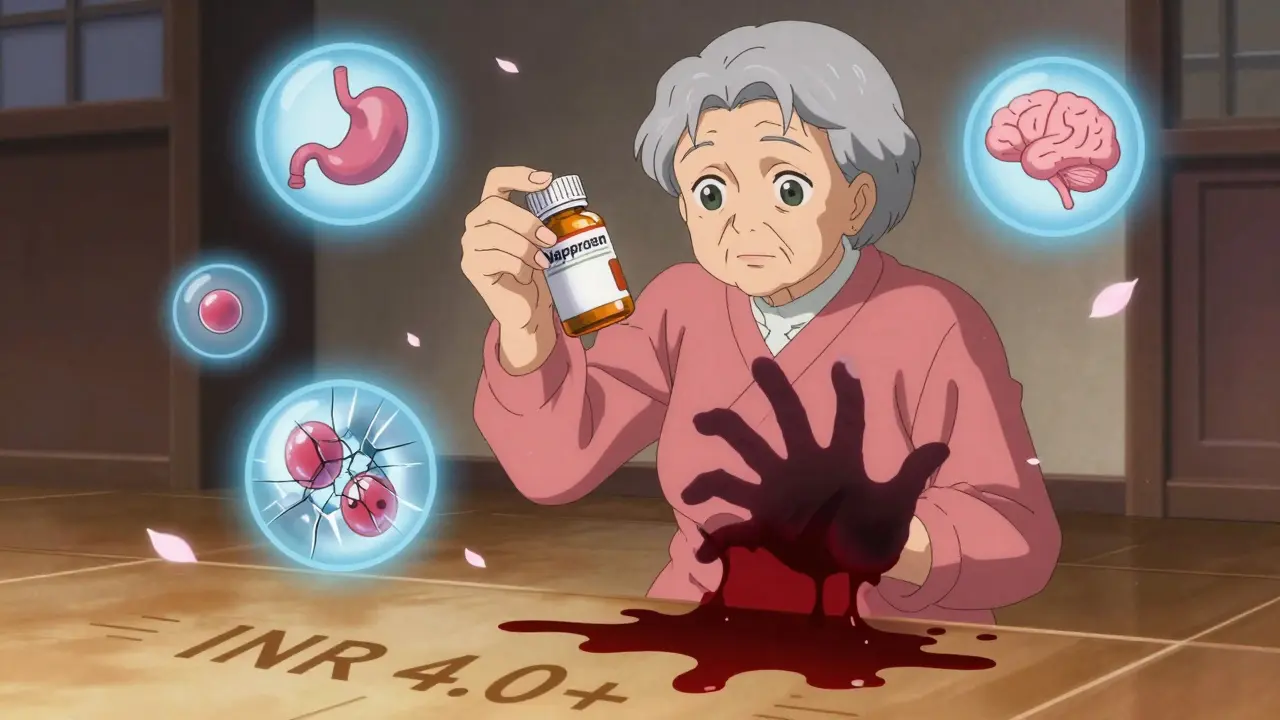
Why Some NSAIDs Are Worse Than Others
Not all NSAIDs are created equal when mixed with warfarin. Naproxen is the worst offender. It has a long half-life-meaning it stays in your system longer. That gives it more time to interfere with platelets and gut lining.
Meloxicam is another red flag. A 2010 study found it was an independent predictor of INR spikes, even after adjusting for other factors. That’s unusual. Most NSAIDs behave similarly, but meloxicam seems to have a stronger interaction with warfarin metabolism.
Diclofenac also carries high risk, especially for GI bleeding. Ibuprofen is a bit safer-but still risky. A 2024 meta-analysis confirmed that even short-term use of any NSAID with warfarin increases GI bleeding risk by 2-fold.
Aspirin? It’s technically an NSAID too. And it’s even worse. It irreversibly blocks platelets for their entire lifespan (7-10 days). If you’re on warfarin and take daily low-dose aspirin, you’re essentially doubling down on bleeding risk.
Who’s Most at Risk?
It’s not just about the drugs. Certain people are far more vulnerable:
- Those on high-dose warfarin (>40 mg per week)
- People taking three or more other medications
- Those with a low baseline INR (under 2.0)
- Older adults (over 65)
- People with a history of ulcers or GI bleeding
- Those with kidney disease or liver problems
One study found that patients with a low INR before starting an NSAID were more likely to have dangerous spikes. Why? Because their bodies had less room to handle the added anticoagulant effect. Think of it like a gas tank that’s almost empty-you don’t need much more to overflow.
What About Newer Blood Thinners?
You might be thinking: “What if I switch to a DOAC like apixaban or rivaroxaban? Is it safer?”
Not really. A 2018 study in the Journal of the American College of Cardiology found that NSAIDs still increased bleeding risk with dabigatran, even if the increase wasn’t statistically different from warfarin. The absolute risk? Higher. GI bleeding still made up 40% of major events. Non-GI bleeding, like brain or muscle bleeds, was even more common.
A 2021 meta-analysis confirmed this: NSAIDs raise bleeding risk with all oral anticoagulants. The mechanism might differ-DOACs target factor Xa or thrombin directly-but the result? The same: more bleeding.

What Should You Do?
If you’re on warfarin and need pain relief:
- Try acetaminophen (paracetamol) first. Up to 3,000 mg per day is generally safe with warfarin. It doesn’t affect platelets or the stomach lining.
- Use topical NSAIDs. Gels like diclofenac gel applied to the skin don’t raise INR. They’re great for joint pain.
- Consider physical therapy. Stretching, heat, or even acupuncture can reduce pain without drugs.
- If you must use an oral NSAID, pick the lowest dose for the shortest time. Avoid naproxen and meloxicam. Ibuprofen is the least bad-but still risky.
- Always take a proton pump inhibitor (PPI). Pantoprazole 40 mg daily protects your stomach lining. It’s not optional if you’re on both drugs.
- Get your INR checked within 3-5 days after starting any NSAID. Then weekly until stable.
- Know the signs of bleeding: Unusual bruising, dark stools, blood in urine, headaches, dizziness, or vomiting blood. Call your doctor immediately.
Why This Still Happens
Despite all the evidence, a 2022 study found that nearly 30% of warfarin users got an NSAID prescription within a year. Why? Because pain is real. Doctors forget. Patients don’t tell them. Pharmacies don’t flag it.
It’s not just about knowledge. It’s about systems. A patient with knee pain might go to their primary care doctor, get an NSAID prescription, and never mention they’re on warfarin. The doctor doesn’t check their medication list. The pharmacist doesn’t have a warning system. The result? A preventable hospitalization.
The Bottom Line
Warfarin and NSAIDs don’t just interact. They collide. And when they do, your body loses its ability to stop bleeding. The risk isn’t theoretical. It’s proven. It’s measured. It’s deadly.
There’s no safe way to combine them. Only less dangerous ways. And even those require strict monitoring.
If you’re on warfarin, don’t take an NSAID without talking to your doctor. And if your doctor prescribes one, ask: “Is this absolutely necessary? What’s the alternative? How often will we check my INR?”
Your life isn’t worth the gamble.
Can I take ibuprofen with warfarin if I only use it once in a while?
Even occasional use of ibuprofen with warfarin can spike your INR. A single dose can affect platelet function for days. Studies show bleeding risk increases even with short-term NSAID use. If you need pain relief, use acetaminophen instead. If you must use ibuprofen, get your INR checked within 3-5 days and avoid regular use.
Why is naproxen riskier than other NSAIDs?
Naproxen has a longer half-life, meaning it stays active in your body for up to 12-18 hours. This gives it more time to inhibit platelets and damage your stomach lining. Studies show it increases bleeding risk 4.1 times compared to warfarin alone-higher than any other NSAID. It’s also more likely to interact with warfarin metabolism, making INR spikes more frequent and severe.
Does taking a PPI like pantoprazole make it safe to combine NSAIDs and warfarin?
PPIs protect your stomach lining and reduce GI bleeding risk, but they don’t fix the platelet problem. NSAIDs still impair clotting, and warfarin still weakens coagulation. So while a PPI lowers your risk of ulcers, it doesn’t eliminate the danger of brain bleeds, muscle bleeds, or other serious bleeding events. It’s a partial shield-not a full solution.
Can I switch from warfarin to a DOAC to avoid this interaction?
Switching to a DOAC like apixaban or rivaroxaban doesn’t solve the problem. Studies show NSAIDs still raise bleeding risk with DOACs. The mechanism is different, but the outcome is the same. DOACs are easier to manage without diet restrictions, but they don’t protect you from NSAID-related bleeding. The safest choice is still to avoid NSAIDs altogether.
What are the signs of bleeding I should watch for?
Watch for unexplained bruising, nosebleeds that won’t stop, pink or red urine, black or tarry stools, vomiting blood (which may look like coffee grounds), severe headaches, dizziness, or sudden weakness. These could signal internal bleeding. If you notice any of these while taking warfarin and an NSAID, seek medical help immediately.
Is it safe to take aspirin with warfarin for heart protection?
No. Low-dose aspirin is an NSAID and a powerful antiplatelet drug. Combining it with warfarin doubles the risk of bleeding without clear benefit for most people. Guidelines from the American College of Chest Physicians recommend against this combination unless you have a specific heart condition that absolutely requires both. Even then, it’s high-risk and needs close monitoring.
Can alcohol make the interaction worse?
Yes. Alcohol affects liver function, which is where warfarin is metabolized. It can raise INR levels and increase bleeding risk. Mixing alcohol with NSAIDs also damages the stomach lining. So combining alcohol, NSAIDs, and warfarin creates a triple threat. Limit alcohol to one drink per day or avoid it entirely if you’re on warfarin.
What should I do if my doctor prescribes an NSAID while I’m on warfarin?
Ask three questions: 1) Is there a safer alternative? 2) How long will I need this? 3) Will my INR be checked within 3-5 days? If the answer to any is no, ask for a second opinion. Never start a new medication without reviewing your full list of drugs with your pharmacist or anticoagulation clinic.


tynece roberts
so like... i was on warfarin for like 3 years after my pulmonary embolism, and my doc just kept giving me ibuprofen for my knees. i didnt even know it was a thing until i started pooping black stuff one morning. yeah. that happened. turned out my inr was 6.8. they pumped me full of vitamin k and i spent 3 days in the hospital. never again. now i just take tylenol and cry in the shower when my arthritis flares. also, why do doctors just assume we know this stuff? i didnt even know what an inr was before this.
Byron Boror
THIS is why america is falling apart. people think they can just pop pills like candy and not deal with consequences. you want pain relief? toughen up. go for a walk. stretch. stop being a snowflake. if you can't handle a little joint pain without poisoning your blood, maybe you shouldn't be allowed to drive. this isn't rocket science. warfarin + NSAIDs = bleeding. end of story. stop blaming doctors. take responsibility.
Lorna Brown
It's fascinating how we treat medication interactions like they're just technical glitches rather than biological symphonies. Warfarin doesn't just 'thin' blood-it delicately tilts the coagulation cascade into a precarious equilibrium. NSAIDs? They don't just 'block' COX-1; they sabotage the very architecture of hemostasis at the platelet and mucosal level. The real tragedy isn't the interaction-it's that we've normalized risk because convenience is king. We've turned healthcare into a transaction, not a relationship. And now, people die because someone didn't ask, 'What else are you taking?' Not because they didn't know. Because they weren't listened to.
Rex Regum
Oh wow, another 'medical horror story' designed to scare people into submission. Let me guess-this was written by a pharmaceutical rep who hates NSAIDs because they're cheaper than DOACs. Wake up. People have been taking ibuprofen with warfarin for decades. My uncle did it for 12 years. No bleed. No hospital. No drama. Meanwhile, the system is so obsessed with liability that it's turning every minor pain into a life-or-death emergency. Stop gaslighting patients. If you're healthy, you don't need 7 different warnings. Just let people make their own damn choices.
Kelsey Vonk
thank you for this. i’ve been on warfarin since 2021 and i’ve been too scared to ask my dr about pain meds. i’ve been using a diclofenac gel for my elbow and it’s been fine, but i didn’t know if i was being reckless. also, i use a heating pad and do yoga every morning-it’s not perfect, but it helps. i’m so glad someone said to use acetaminophen. i’ve been taking 3,000 mg daily and didn’t realize it was safe. 🙏
Jimmy V
Let’s cut through the noise: acetaminophen is your best friend. Topical NSAIDs? Solid. PPI? Non-negotiable. INR check within 72 hours? Mandatory. If you’re taking naproxen with warfarin, you’re playing Russian roulette with your internal organs. And yes, aspirin counts. No, PPIs don’t fix platelet dysfunction. No, DOACs aren’t magic. And yes, your 78-year-old grandma with kidney disease and a history of ulcers shouldn’t be getting a 3-month supply of diclofenac from a 3-minute telehealth visit. This isn’t opinion. It’s physiology. Stop making excuses. Save lives.
Katherine Rodriguez
why do we even need to talk about this its obvious you cant mix them
Devin Ersoy
Oh honey, I love how we've turned a simple pharmacological interaction into a full-blown moral panic. I mean, really? 'Your life isn't worth the gamble'? Dramatic much? I’ve got a friend who’s on warfarin, drinks whiskey daily, smokes, and takes naproxen for her back-and she’s 82 and still gardening. The data? Sure, it’s statistically significant. But medicine isn’t math. It’s lived experience. Sometimes, the risk is worth the quality of life. Not everyone wants to live in a bubble. Maybe we should stop scaring people and start trusting them.
Scott Smith
As someone who manages anticoagulation clinics for a living, I’ve seen too many preventable bleeds. The real issue isn't the drugs-it's the system. Primary care docs don't have time. Pharmacists aren't alerted. Patients don't know to mention OTC meds. We need automated alerts in EHRs, mandatory pharmacist counseling, and better patient education. This isn't about blame. It's about design. If we build systems that catch these interactions before they happen, we stop the bleeding before it starts.
tamilan Nadar
in india we dont have this problem much because people use turmeric and ginger paste for joint pain. also most take paracetamol. warfarin is not common here. but if someone is on it, they are usually under a cardiologist. no one just buys ibuprofen at the corner shop and takes it. maybe we need more awareness here too. but the culture is different. we dont overmedicate.
Adam M
if you're on warfarin and you're still using NSAIDs, you're not a patient. you're a liability.