
Splitting Doses: How Lowering Peak Concentrations Can Reduce Medication Side Effects
Medication Splitting Safety Checker
Enter your medication name to check if it's safe to split doses to reduce side effects. Based on the latest medical guidelines and the article content.
Enter a medication name to get results
Ever wonder why your doctor suddenly suggests taking half your pill twice a day instead of the whole thing once? It’s not about saving money-though that’s a common reason. It’s about peak concentration. When you take a full dose all at once, your body absorbs it quickly, creating a spike in drug levels. That spike is often what causes side effects like nausea, dizziness, or even dangerous drops in blood pressure. Splitting the total daily dose into smaller, more frequent doses can smooth out those peaks, making treatment easier to tolerate-if it’s done right.
What Dose Splitting Really Means (And What It Doesn’t)
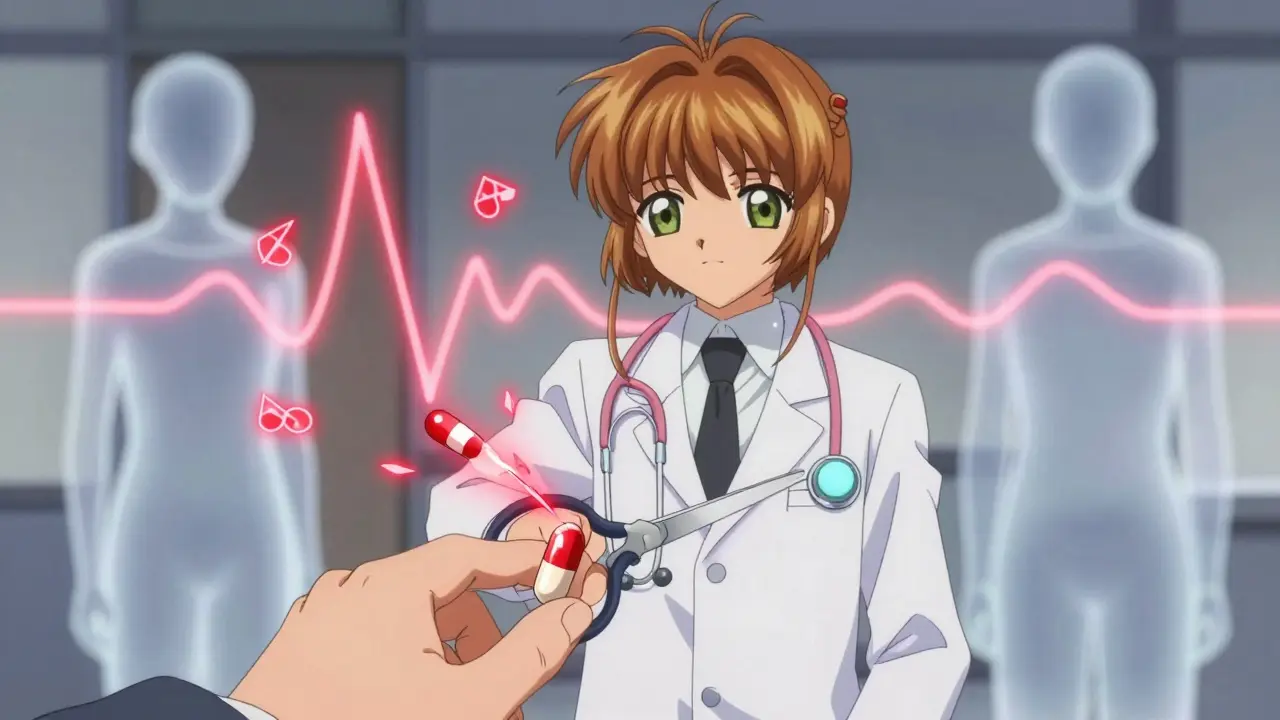
People often confuse dose splitting with tablet splitting. They’re not the same. Tablet splitting is physically cutting a pill in half-maybe with a knife, scissors, or a cheap pill splitter. Dose splitting is a clinical strategy: taking the same total daily amount, but dividing it into two or more smaller doses spread throughout the day. For example, instead of 20 mg of lisinopril once a day, you take 10 mg twice a day. The total is the same. The timing changes. That’s the key.
Tablet splitting can be risky. If you cut an extended-release tablet, you’re breaking open a time-release system. The drug floods into your system all at once. A 40 mg extended-release lisinopril tablet cut in half doesn’t give you two 20 mg doses-it gives you one massive, unsafe spike. The FDA has logged over 1,200 adverse events between 2015 and 2020 from people splitting pills they shouldn’t have. Thirty-eight percent of those involved blood thinners like warfarin. One wrong split can mean a trip to the ER.
When Dose Splitting Works: The Science Behind Smoother Peaks
Not all drugs respond the same way. The magic happens with medications that have a short half-life-meaning your body clears them quickly. If a drug lasts less than 6 hours in your system, taking it once a day leaves you with too little at the end of the day and too much right after you swallow it. That’s when peak concentration becomes a problem.
Take metformin. Many people can’t tolerate the GI side effects-diarrhea, cramps, nausea-when they take 1,000 mg twice a day. But if they split that same 2,000 mg total into 500 mg four times a day, the peaks drop. One Reddit user reported diarrhea dropped from 60% of doses to just 15%. That’s not luck. It’s pharmacokinetics. Your body handles smaller, more frequent doses better because it doesn’t get overwhelmed.
Same goes for immediate-release opioids like oxycodone. High doses can cause nausea and dizziness. Splitting the daily dose into three smaller doses reduces those side effects without losing pain control. A 2023 ASHP guideline lists 14 drug classes where dose splitting can help, including stimulants (for jitteriness), antipsychotics (for sedation), and certain blood pressure meds.
When It’s Dangerous: The Narrow Therapeutic Index Trap
Some drugs don’t have room for error. Their therapeutic index is narrow-meaning the difference between a helpful dose and a toxic one is tiny. Digoxin, warfarin, and lithium fall into this category. For warfarin, the target INR range is 2 to 3. If your dose spikes too high, you risk bleeding. If it drops too low, you risk a clot. Even a 10% variation in dose can push you out of that window.
Splitting warfarin tablets is a recipe for trouble. Studies show inappropriate splitting can increase adverse events by 15-20%. The European Medicines Agency says if a split tablet varies by more than 15% in drug content, it shouldn’t be labeled as splittable. About 22% of scored tablets fail this test. That’s why pharmacists often refuse to fill prescriptions for split warfarin. The risk isn’t worth it.
Tablet Splitting: When It’s Okay (And How to Do It Safely)
Some pills are designed to be split. They have a score line, are immediate-release, and have been tested for uniformity. Levothyroxine, for example, is commonly split for dose adjustments. GoodRx surveys show 68% of patients who split levothyroxine report no issues. Why? Because it’s stable, has a long half-life (7 days), and a wide therapeutic index.
If you must split a tablet:
- Use a dedicated pill splitter-not a knife or scissors. Knife splits vary by up to 25%. Pill splitters keep variation under 8%.
- Only split pills that are scored and labeled as splittable by the manufacturer or FDA.
- Split just before taking it. Don’t store split tablets for more than a week. Exposure to air and moisture can degrade the drug.
- Check with your pharmacist. Ask: “Is this tablet safe to split? Does it have an extended-release coating?”
UBC research shows that without proper training, 65% of people split pills with more than 15% dose variation. With training, that drops to 12%. That’s the difference between safe and dangerous.
Cost vs. Safety: The Real Trade-Off
A lot of people split pills to save money. Atorvastatin 80 mg tablets cost about $15 a month. Splitting them gives you two 40 mg doses-same effect, half the price. GoodRx says this can save up to $300 a year. That’s tempting. But here’s the catch: if you split a pill that shouldn’t be split, you risk hospitalization. The FDA estimates inappropriate splitting adds $12.3 billion in avoidable healthcare costs annually in the U.S. That’s more than the $8.9 billion saved by splitting.
Pharmaceutical companies are catching on. Pfizer now offers 5 mg and 10 mg versions of rivaroxaban, instead of just 20 mg. Since then, inappropriate splitting dropped by 78%. The trend is clear: better dosing options beat risky splitting.
What You Should Do Next
If you’re thinking about splitting your dose:
- Check your medication’s label. Does it say “do not split” or “extended-release”? If yes, don’t.
- Look up the drug’s half-life. If it’s under 6 hours, dose splitting might help. If it’s over 12 hours, probably not.
- Find out your drug’s therapeutic index. If it’s below 2 (like digoxin or warfarin), don’t split.
- Ask your pharmacist: “Is this tablet safe to split? Will splitting change how it works?”
- If approved, use a proper pill splitter and take the split dose immediately.
Don’t assume your doctor knows you’re splitting pills. Tell them. They need to monitor your response. For high-risk drugs, expect a follow-up blood test within 7 days after changing your dosing schedule.
What’s Coming Next
The NIH is running a trial called SPLIT-PEAK (NCT05521034) to see if splitting venlafaxine doses reduces nausea from 32% to 18% without losing effectiveness. Early results are promising. Meanwhile, seven pharmaceutical companies have pending patents for “smart” tablets with engineered split lines that preserve extended-release properties. These could be the future-safe splitting without the guesswork.
For now, though, the rule is simple: if you’re unsure, don’t split. Talk to your doctor or pharmacist. The goal isn’t to cut pills. It’s to reduce side effects safely. And sometimes, the safest option is just taking the right dose from the start.
Can I split my blood pressure pill to reduce dizziness?
It depends. If your pill is an immediate-release version like lisinopril or hydrochlorothiazide, and your doctor approves, splitting the daily dose into two smaller doses can lower peak concentrations and reduce dizziness. But if it’s extended-release (like amlodipine besylate ER or felodipine SR), splitting it can cause dangerous spikes in drug levels. Always check the label and ask your pharmacist.
Is it safe to split my antidepressant?
Some antidepressants can be safely split, others can’t. Sertraline has a long half-life (25-26 hours), so even if you split a tablet unevenly, your body buffers the change. But venlafaxine has a short half-life and causes nausea at high peaks-splitting its dose under medical supervision may help. Never split extended-release versions like Effexor XR. Always confirm with your prescriber.
Why does my pharmacist say not to split my warfarin tablet?
Warfarin has a very narrow therapeutic index-your blood needs to stay in a very tight range (INR 2-3). Even a 10% variation in dose can push you into dangerous territory, increasing bleeding or clotting risk. Studies show inappropriate splitting raises adverse events by 15-20%. Most pharmacists won’t fill split warfarin prescriptions because the risk is too high.
Can I split my metformin to stop the stomach upset?
Yes, and many people do. Metformin immediate-release causes GI side effects because of high peak concentrations. Splitting your total daily dose (e.g., from 1,000 mg twice a day to 500 mg four times a day) reduces those peaks and often cuts diarrhea and nausea by more than half. Make sure it’s the immediate-release version-not the extended-release (XR or ER) version.
How do I know if my pill is safe to split?
Look for a score line, check the label for “do not split,” and ask your pharmacist. The FDA and Australian Prescriber list specific drugs that are safe to split-like levothyroxine, atorvastatin, and some beta-blockers. Avoid splitting enteric-coated, extended-release, or capsule-form medications. If you’re unsure, assume it’s not safe.
What’s the best way to split a pill?
Use a dedicated pill splitter with a sharp blade and a secure holder. Never use a knife or scissors-they create uneven splits. Split the pill right before taking it. Store unsplit pills in their original container. If you must split ahead of time, keep split halves in a dry, cool place and use them within a week. Always wash your hands before handling.
Can splitting pills cause long-term harm?
Yes, if done incorrectly. Splitting extended-release or enteric-coated pills can lead to sudden drug spikes, causing toxicity. Splitting narrow-therapeutic-index drugs like warfarin or digoxin can lead to strokes, clots, or heart rhythm problems. Even if you feel fine now, inconsistent dosing can damage organs over time. The harm isn’t always immediate-it’s cumulative.


Kathryn Featherstone
I started splitting my metformin after reading this, and wow-my stomach stopped screaming at me. I was taking 1000mg twice a day and felt like I’d been hit by a bus every morning. Switched to 500mg four times a day, and suddenly I could eat breakfast without panic. It’s not magic, it’s just biology working right.
Mark Able
My grandma splits her warfarin with a kitchen knife and swears by it. She’s 82 and still gardening. You people act like we’re all gonna drop dead if we cut a pill in half. Chill out. The system’s not that fragile.
Kevin Motta Top
Splitting pills isn’t about cutting tablets. It’s about respecting your body’s rhythm. Your liver doesn’t want a flood-it wants a trickle. That’s why timing matters more than dosage.
Alisa Silvia Bila
My pharmacist gave me a free pill splitter after I asked about my lisinopril. She said, ‘If it’s scored and not ER, you’re fine.’ Simple advice. Why do we overcomplicate this?
Marsha Jentzsch
Oh my GOD, someone finally said it!! I’ve been screaming this for years!! People are CUTTING THEIR VENLAFAXINE XR TABLETS WITH SCISSORS AND THINKING IT’S ‘FINE’-NO!! IT’S NOT FINE!! IT’S A MEDICAL DISASTER WAITING TO HAPPEN!! I HAD A FRIEND WHO ENDED UP IN THE ER BECAUSE SHE DID THIS!! WHY WON’T DOCTORS TELL PEOPLE THIS??
Chris porto
It’s funny how we treat medicine like a vending machine-push the button, get the result. But our bodies aren’t machines. They’re ecosystems. A spike isn’t just ‘too much’-it’s chaos. Smoothing the curve isn’t just safer-it’s more respectful to how we’re built.
mary lizardo
While the article presents a compelling argument grounded in pharmacokinetic principles, it is regrettable that the author fails to cite peer-reviewed meta-analyses from the Journal of Clinical Pharmacology or the British Journal of Clinical Pharmacology to substantiate the 15-20% adverse event statistic. Without such rigorous sourcing, the narrative risks devolving into anecdotal alarmism.
Kinnaird Lynsey
Mark, your grandma’s knife might work for her… but it’s not a public health strategy. And Marsha? You’re right to panic-but maybe don’t type in all caps at 3 a.m. on Reddit. We get it. Pill splitting can kill. Let’s just… not make it a horror story.