
European Generic Markets: How Regulatory Approaches Across the EU Shape Drug Access and Pricing

When you pick up a generic pill in Germany, France, or Poland, you might think it’s just a cheaper version of the brand-name drug. But behind that simple label is one of the most complex regulatory systems in the world. In the European Union, getting a generic medicine to market isn’t just about proving it works-it’s about navigating four different approval paths, 27 national bureaucracies, and a major regulatory overhaul that just changed the game in 2025.
The Four Ways Generics Get Approved in the EU
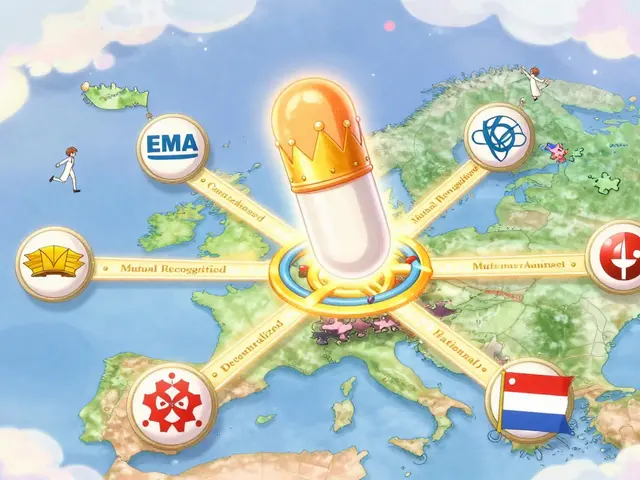
There’s no single route for generic drugs in Europe. Instead, manufacturers choose from four distinct pathways, each with its own timeline, cost, and challenges. The choice isn’t random-it’s a strategic decision that can make or break a product’s launch. The Centralized Procedure is the fastest way to get a generic drug approved across all 27 EU countries, plus Iceland, Liechtenstein, and Norway. You submit one application to the European Medicines Agency (EMA), and if approved, you get a single marketing authorization valid everywhere. Sounds simple, right? But it’s expensive. Application fees alone run around €425,000, and you’ll need another €1.2 to €1.8 million in consulting and study costs. Only companies targeting high-value generics-those expected to sell over €250 million across the EU-usually go this route. Sandoz used it to launch its version of Novartis’s Cosentyx in Q2 2025, hitting all markets at once-11 months faster than other methods allowed. The Mutual Recognition Procedure (MRP) is the most popular, used in 42% of cases. Here, a company gets approval in one country first-the Reference Member State-and then asks others to recognize it. It’s cheaper, costing between €180,000 and €220,000. But it’s slow and messy. Even after EMA approves the science, each country can drag its feet on pricing or reimbursement. Teva’s generic rosuvastatin got technical approval in Germany in 2023, but Dutch and Belgian markets didn’t see it for over eight months because of local negotiations. The Decentralized Procedure (DCP) lets companies apply to multiple countries at the same time, without needing prior approval anywhere. It’s meant to be faster than MRP, but it’s often the most frustrating. A 2024 study found that 37% of DCP applications hit delays longer than six months. Why? Because countries like Poland, Romania, or Bulgaria sometimes demand extra tests or paperwork that don’t exist in EMA guidelines. The clock resets every time one country raises an objection. For manufacturers, this means unpredictable timelines and supply chain nightmares. Then there’s the National Procedure, used in just 5% of cases. You apply to one country only. It’s useful if you’re targeting a single high-reimbursement market like France, where certain generics get better pricing. But it defeats the whole point of EU harmonization. Accord Healthcare found it took 197 days to get a national approval in France-yet with MRP, they got the same drug approved in five other countries in just 142 days.What the EU Pharma Package 2025 Changed
In June 2025, the EU rolled out its biggest overhaul of generic drug rules in 20 years. The changes weren’t subtle. They touched everything from how long brand-name drugs are protected to when generics can start negotiating prices. One of the biggest shifts was shortening Regulatory Data Protection. Before, brand-name companies had 10 years of protection-eight years of data exclusivity plus two years of market exclusivity. Now, it’s 8 years plus 1 year of market protection. That’s it. You can extend it to 10 years total if the drug meets public health goals, like treating rare diseases. This change alone could bring generics to market months earlier for dozens of high-cost drugs. The Bolar exemption got a major boost too. Before, generic makers could only start negotiating prices with health systems two months before the patent expired. Now, they can start six months early. That might not sound like much, but it’s huge. REMAP Consulting estimates this alone will cut generic launch delays by 4.3 months on average. It also gives payers more power. Hospitals and insurers can now compare prices and demand discounts before the drug even hits shelves. That’s why analysts predict generic launch prices could drop 12-18% in the next few years. There’s also a new obligation to supply rule. If a generic manufacturer gets approval, they can’t just sit on it. They must produce enough to meet demand. National authorities can now force them to ramp up production if shortages occur. That’s meant to fix the chronic problem of drug shortages in smaller countries. But experts like Professor Panos Kanavos warn that if countries interpret “sufficient quantities” too loosely, they might still block supply in low-volume markets.Why National Differences Still Matter
Even with EU-wide rules, every country has its own quirks. The EMA sets the science. But each national authority decides how to apply it. Germany’s BfArM, for example, requires extra pharmacodynamic studies for complex generics like inhalers-tests that aren’t required by EMA. France’s ANSM demands special documentation for pediatric formulations. Italy has stricter limits on impurities in older drugs. These aren’t just paperwork hurdles-they add months to timelines and tens of thousands to costs. A 2025 survey of 47 generic manufacturers found that 68% listed inconsistent national bioequivalence requirements as their biggest headache. One company spent six months redoing studies because Spain and Austria disagreed on how to measure absorption rates for a generic asthma inhaler. The EMA’s guidance says one thing. The national regulator says another. And the generic company pays the price.
Who’s Winning in the EU Generic Market?
The EU generic market was worth €42.7 billion in 2024, growing 6.2% from the year before. But who’s getting the biggest slice? Indian companies now control 38% of all EU generic approvals-up from 29% in 2020. Their low-cost manufacturing and aggressive pricing make them tough to beat on volume. But European firms like Sandoz and Viatris still hold 52% of the market share-not because they’re cheaper, but because they’re smarter about pathways. They use the Centralized Procedure for high-value drugs and stick to MRP for others, minimizing delays and maximizing reach. The 2025 reforms are helping them too. With the Bolar exemption extended, companies can now run parallel health technology assessments (HTA) across multiple countries before launch. That means they can lock in pricing agreements faster. It’s not just about getting approved-it’s about getting paid.What’s Next? The 2026 Deadline and Beyond
The biggest change is still coming. On July 1, 2026, the new Regulatory Data Protection rules fully kick in. That’s when the 8+1 system becomes standard for all new drugs. Around 78 biologics currently in development could see generic versions arrive years earlier than expected. There’s also a new requirement: all product information must be submitted electronically in XML format by 2026. That means every generic company needs to upgrade its IT systems. White & Case estimates this will cost between €180,000 and €250,000 per company. Smaller firms might struggle. Bigger ones? They’ll absorb it. The Critical Medicines Act of March 2025 adds another layer. It forces countries to stockpile 200 essential generics. That sounds good for patients-but it also means stricter quality checks. More inspections. More delays. More cost.
What This Means for Patients
You might not care about MRP vs. DCP. But you care if your prescription is cheaper, available, and reliable. The 2025 reforms are designed to fix exactly that. By speeding up approvals and forcing manufacturers to keep supply flowing, the EU hopes to reduce medicine shortages by 35% by 2028. That’s 1 in 3 fewer times you’ll be told your drug is out of stock. And prices? They’re likely to drop further. With generics entering earlier and payers negotiating harder, the gap between brand and generic prices-already 80% in many cases-could widen even more. But there’s a risk. If the 1-year market protection is too short for complex drugs like biosimilars, companies might stop investing in them. That could leave patients with fewer options for advanced treatments. Right now, generics make up 65% of all prescriptions in the EU by volume. By 2028, that number could hit 69.2%. More access. Lower costs. But only if the system keeps working as intended.What Generic Manufacturers Need to Know
If you’re a company trying to launch a generic in Europe, here’s what you need to do:- Choose your pathway wisely. Centralized for big drugs. MRP for mid-range. National only if you’re targeting one market.
- Start preparing 15-18 months before submission. Bioequivalence studies alone take 6-8 months under the 2025 guidelines.
- Don’t assume EMA rules = national rules. Check each country’s specific requirements-especially Germany, France, and Italy.
- Use the EMA’s free Q&A portal, but verify everything with national authorities. Their responses often contradict EMA guidance.
- Invest in XML-based ePI systems now. The 2026 deadline is real, and penalties are steep.
- Start pricing negotiations 6 months before patent expiry. Don’t wait. The window is open.
Final Thoughts
The EU’s generic drug system isn’t broken. It’s just incredibly complicated. The 2025 reforms are the most meaningful update in decades-aimed at making generics faster, cheaper, and more reliable. But complexity doesn’t vanish overnight. National differences, inconsistent interpretations, and bureaucratic inertia still slow things down. The winners will be the companies that treat this like a chess game-not a checklist. They’ll know when to use the Centralized Procedure, when to push back on national demands, and when to start the pricing talks. For everyone else? The wait will be longer, the costs higher, and the risks greater.For patients, the goal is clear: more generics, sooner. And if the EU can make that happen, it won’t just save money-it could save lives.
How long does it take to get a generic drug approved in the EU?
The time varies by approval pathway. The Centralized Procedure takes about 210 days for assessment, plus 67 days for final approval-around 9 months total. The Mutual Recognition Procedure averages 133 days but can stretch to over a year due to national delays. The Decentralized Procedure takes 247 days on average, often longer because of repeated objections. The National Procedure takes 180-240 days, depending on the country. The 2025 reforms aim to cut these times, especially with the expanded Bolar exemption allowing pricing talks to start six months before patent expiry.
What’s the difference between the Centralized and Decentralized Procedures?
The Centralized Procedure requires one application to the EMA and results in approval across all EU countries at once. It’s fast for market access but expensive-costing over €1.6 million total. The Decentralized Procedure lets you apply to multiple countries simultaneously without prior approval, but each country can reject or delay the application. It’s cheaper upfront but riskier-37% of applications face delays longer than six months due to inconsistent national requirements.
Why are Indian companies getting more generic approvals in the EU?
Indian manufacturers have built low-cost, high-volume production systems that meet EMA quality standards. They’re also more aggressive in pursuing multi-country approvals through MRP and DCP. In 2024, they secured 38% of all EU generic approvals-up from 29% in 2020-because they can undercut European firms on price while still passing rigorous testing.
Can a generic drug be approved faster after a patent expires?
Yes-thanks to the 2025 Pharma Package, generic manufacturers can now begin pricing and reimbursement negotiations with health systems six months before the patent expires. This cuts an average of 4.3 months off the time to market. It doesn’t speed up the scientific review, but it removes the biggest bottleneck: waiting for payers to decide on price.
Do all EU countries accept the same bioequivalence data?
No. While the EMA sets the baseline standard-80-125% confidence intervals for Cmax and AUC-some countries add extra requirements. Germany demands pharmacodynamic studies for inhalers. France requires pediatric formulation details. Italy has stricter impurity limits for older drugs. This inconsistency is the biggest operational headache for generic manufacturers.
What happens if a generic manufacturer doesn’t supply enough drugs?
Under the 2025 Critical Medicines Act and the new obligation to supply rule, national authorities can legally require manufacturers to increase production if shortages occur. Failure to comply can lead to fines, suspension of marketing authorization, or even replacement by another supplier. This rule was introduced to fix chronic drug shortages in smaller or lower-income EU countries.

Sami Sahil
Bro this is wild 😍 India’s crushing it in EU generics now. 38% approval share? We’re not just making cheap pills-we’re making smart moves. MRP + DCP = boom. EMA says yes, and we’re already shipping. No drama, just volume. 🚀
franklin hillary
The EU’s system is a masterpiece of bureaucratic chaos and genius all at once. You’ve got a single market with 27 different personalities trying to agree on what ‘bioequivalent’ means. And somehow it works? The Bolar exemption? That’s the quiet revolution. Paying for drugs before they even hit the shelf? That’s not regulation-that’s power shift. The patients win. The pharma giants? They’re sweating.
Ishmael brown
Wait… so the EU is forcing companies to make more drugs? 😏 Sounds like a trap. What if they just… don’t? And then blame the ‘small countries’ for not having enough? I’ve seen this before. ‘Supply obligation’ = government pressure to produce, but no real funding. They’ll make the pills… but quietly hide them in warehouses. The real shortage? Trust.
Jaden Green
Let’s be honest-this entire regulatory framework is an overengineered mess designed to protect Big Pharma under the guise of ‘patient safety.’ The Centralized Procedure costs over a million euros? That’s a tax on competition. The fact that Germany demands extra pharmacodynamic studies for inhalers that aren’t even in the EMA guidelines? That’s not science-it’s protectionism dressed up as quality control. And don’t get me started on XML ePI by 2026-another $250k burden for small firms who can’t afford consultants. This isn’t harmonization. It’s exclusion.
Lu Gao
The 8+1 data protection rule? Brilliant. 🙌 Finally, someone’s cutting through the red tape. And the Bolar exemption extension? That’s the kind of smart policy that actually helps people. No more waiting six months to negotiate prices-now payers can act like adults. Also, Indian companies are not ‘cheap’-they’re efficient. And efficiency shouldn’t be a dirty word.
Angel Fitzpatrick
You think this is about access? Nah. The EU Pharma Package 2025? It’s a Trojan horse. The ‘obligation to supply’ rule? That’s the first step. Next thing you know, they’ll mandate where you store the pills, who can prescribe them, and force pharmacies to stock only generics. Then comes the digital ID for every pill. Then the blockchain tracking. Then the AI that decides if you ‘deserve’ your medication. They’re not fixing shortages-they’re building a control system. And you’re applauding it.
Melissa Melville
So… Germany requires extra tests for inhalers. France wants pediatric docs. Italy cares about impurities from 1998. And we’re all supposed to be impressed by ‘harmonization’? 😅 I’m just glad I don’t have to file paperwork in 27 languages. I’d cry. Or quit. Probably both.
Bryan Coleman
Honestly? The biggest win here is the Bolar exemption. Six months to start pricing talks? That’s huge. I work in hospital procurement and we used to get zero notice. Now we can actually plan. No more scrambling when a drug drops. Also, Indian firms? Respect. They’re playing the long game. Not just cheap-strategic.
Naresh L
It’s fascinating how the EU balances unity and fragmentation. The EMA sets the science, but the nations decide the soul. That’s not a flaw-it’s a feature. Every country has its own healthcare DNA. You can’t force a German hospital to think like a Greek one. The real question: can the system adapt fast enough? The 2026 XML deadline might break smaller players. But maybe that’s the point.
June Richards
Oh please. ‘More generics, sooner’? Sounds great until you realize the only ones benefiting are the big pharma conglomerates who bought out the small generic makers. Now they control the supply chains. The ‘obligation to supply’? That’s just a fancy way to say ‘we’ll fine you if you don’t make enough for our underfunded systems.’ This isn’t reform. It’s consolidation with a smile.
Nancy Nino
I am genuinely moved by the potential of this reform. The 2025 changes represent a paradigm shift in public health policy-not merely regulatory tinkering, but a profound reorientation toward patient-centered outcomes. The extension of the Bolar exemption, in particular, is a masterstroke of economic foresight and ethical governance. One can only hope that member states will implement these provisions with the urgency and integrity they deserve.
Aditya Gupta
India’s winning because we don’t wait for permission. We just build. EMA says 80-125%? We hit 95%. Germany wants extra tests? We do ‘em. France needs pediatric docs? We add ‘em. No drama. Just results. And yeah, we’re cheap-but we’re also reliable. That’s the real story.
Donna Macaranas
I’ve seen how messy this gets from the inside. One country rejects a batch because of a 0.01% impurity that’s fine everywhere else. Then you have to retest. And retest. And retest. It’s exhausting. But I’m glad they’re forcing supply. I’ve had patients go without because a pill ‘wasn’t approved’ in their country. That’s not science. That’s cruelty.
Rachel Liew
this is so important but no one talks about it. my dad had to wait 3 months for his generic blood pressure med because it 'wasnt available' in his state. then it showed up. he had no idea why. this whole system needs to be simpler. people just want their meds. not a 50-page report on regulatory pathways.
Ed Di Cristofaro
You call this reform? This is just Big Pharma’s way of making sure only the giants survive. Small generic companies? Dead. The XML requirement? A $250k tax on startups. And don’t even get me started on the ‘obligation to supply’-that’s just state coercion wrapped in a nice suit. They’re not helping patients. They’re controlling the market.