Dry Mouth from Medications: Why It Happens and How to Manage It
Medication Dry Mouth Risk Checker
Check Your Medication Risk
Enter your medications to see dry mouth risk percentages and alternative options.
Your Medication Risk Summary
Risk Score: 0What This Means
Most dry mouth cases occur in people taking 3+ medications. Your risk increases with each high-risk medication. 42% of cases improve with medication changes.
If you're experiencing dry mouth, talk to your doctor about lower-risk alternatives and management options.
Millions of people wake up every morning with a cottony, sticky feeling in their mouth-not because they forgot to brush, but because of the pills they take. Dry mouth from medications, known medically as xerostomia is a condition where saliva production drops significantly due to drug use, is one of the most common, yet overlooked, side effects of prescription and over-the-counter medicines. It’s not just uncomfortable. Left unmanaged, it can lead to rapid tooth decay, mouth infections, difficulty swallowing, and even nutritional problems. In Australia, where over 60% of adults over 65 take at least five medications daily, this isn’t a rare issue-it’s a daily reality for tens of thousands.
Why Do Medications Cause Dry Mouth?
Your saliva doesn’t just help you taste food or speak clearly. It’s your mouth’s natural defense system. It washes away food particles, neutralizes acids, and protects your teeth from bacteria. When medications interfere with the nerves that tell your salivary glands to produce saliva, things go wrong. The main culprit? Drugs that block a chemical called acetylcholine. This neurotransmitter is the signal that tells your salivary glands: "Start making saliva." When it’s blocked, production drops-sometimes by as much as 85%.
About 68% of drugs linked to dry mouth are anticholinergic, meaning they directly interfere with this signal. These include common medications for overactive bladder (like oxybutynin and tolterodine), allergies (diphenhydramine), depression (amitriptyline), and even some Parkinson’s and motion sickness drugs. A 2022 review from the American Academy of Oral Medicine found over 1,110 medications with this effect. That’s more than half of all commonly prescribed drugs.
It’s not just one drug. The more pills you take, the worse it gets. People on three or more medications are 2.3 times more likely to have severe dry mouth than those on one. For older adults-especially those over 65-this is a major concern. Nearly 76% of all dry mouth cases happen in this group, and 38% of them take five or more prescriptions daily. Many don’t even realize their dry mouth is drug-related. They just think it’s "getting older."
Which Medications Are the Worst?
Not all drugs affect saliva the same way. Some are far more likely to cause dry mouth than others. Here’s what the data shows:
| Medication Type | Example Drug | Percentage of Users with Dry Mouth | Lower-Risk Alternative |
|---|---|---|---|
| Overactive Bladder | Oxybutynin (Detrol) | 70% | Solifenacin (Vesicare) - 49% |
| Antihistamines (1st Gen) | Diphenhydramine (Benadryl) | 58% | Loratadine (Claritin) - 12% |
| Tricyclic Antidepressants | Amitriptyline | 63% | Sertraline (Zoloft) - 31% |
| Antipsychotics (Conventional) | Haloperidol | 54% | Aripiprazole - 37% |
| Diuretics | Furosemide | 45% | Spironolactone - 28% |
Notice the pattern? First-generation drugs almost always cause more dry mouth than newer versions. For example, diphenhydramine (Benadryl) is far more likely to dry your mouth than loratadine (Claritin). The same goes for antidepressants: tricyclics like amitriptyline are far worse than SSRIs like sertraline. If you’re on one of these older drugs and struggling with dry mouth, talk to your doctor about switching. In 42% of cases, simply changing the medication improves symptoms without losing effectiveness.
What Happens If You Ignore It?
Dry mouth isn’t just annoying. It’s dangerous. Without enough saliva, your mouth becomes a breeding ground for bacteria. Plaque builds up faster. Cavities form quickly-especially around the gum line and on the roots of teeth. Studies show that people with untreated dry mouth develop root caries (tooth decay on the root surface) at 47% higher rates than those with normal saliva flow. Some patients have lost multiple teeth in under a year, even with perfect brushing habits.
One Reddit user, "XeroWarrior87," shared their story: after starting oxybutynin for bladder control, they developed constant dry mouth. Within six months, they had three new cavities. "I brushed twice a day, flossed, went to the dentist every six months," they wrote. "But my mouth felt like sandpaper. I didn’t realize the medication was the problem until my dentist said, ‘You’ve got medication-induced decay.’"
It gets worse. Dry mouth can make swallowing hard, lead to bad breath, cause mouth sores, and even affect your ability to taste food. Many people stop eating healthy foods like fruits, vegetables, and lean proteins because they’re too hard to chew. That leads to poor nutrition, which affects your whole body.
How to Manage It: A Practical 4-Step Plan
There’s good news: dry mouth from medications can be managed-often with simple, low-cost steps. The American Dental Association recommends this four-step approach:
- Review your meds with your doctor. Ask: "Could any of these be causing dry mouth?" Sometimes, switching to a lower-risk version helps. For example, replacing diphenhydramine with loratadine cuts dry mouth risk from 58% to 12%. Don’t stop any medication on your own-talk to your prescriber first.
- Use a prescription stimulant. If switching drugs isn’t enough, your doctor can prescribe pilocarpine (Salagen) or cevimeline (Evoxac). These drugs mimic acetylcholine and can boost saliva production by up to 72% within weeks. They’re not for everyone-especially if you have heart or asthma issues-but they work well for many.
- Use oral moisturizers daily. Over-the-counter products like Biotene or Xylimelts help. Biotene’s oral rinse provides relief for up to 4 hours in 81% of users. Apply it 5-6 times a day. Keep a bottle at your desk, in your car, and by your bed. Newer formulations like Biotene’s Enzyme-Activated Moisturizing System (launched in 2023) now last up to 7 hours.
- See your dentist more often. If you have dry mouth, don’t wait six months for a checkup. Go every three months. Your dentist can apply fluoride treatments, spot early decay, and recommend special toothpaste (like those with stannous fluoride) to protect your teeth.
Success depends on consistency. Most people see improvement after 6-8 weeks of following these steps. But many quit early because they don’t notice immediate results. Stick with it. The damage to your teeth doesn’t reverse overnight-but stopping it does.
Why Most Doctors Miss This
Here’s the frustrating part: most doctors don’t ask about dry mouth. A 2023 survey of 1,200 primary care doctors found only 28% routinely check for it during medication reviews. Patients rarely bring it up either. They assume it’s normal. But dental professionals are changing. In 2023, 89% of dentists in Australia and the U.S. now ask patients: "What medications are you taking?"-and follow up with, "Do you have dry mouth?"
But even dentists aren’t always trained to manage it. Only 52% feel confident in recommending treatment. That’s why collaboration matters. The best outcomes happen when your dentist and doctor talk. One study of 3,115 patients found that coordinated care reduced dental complications by 57%. If your dentist recommends a change, ask them to send a note to your GP. If your doctor prescribes a new drug, ask if it’s linked to dry mouth.
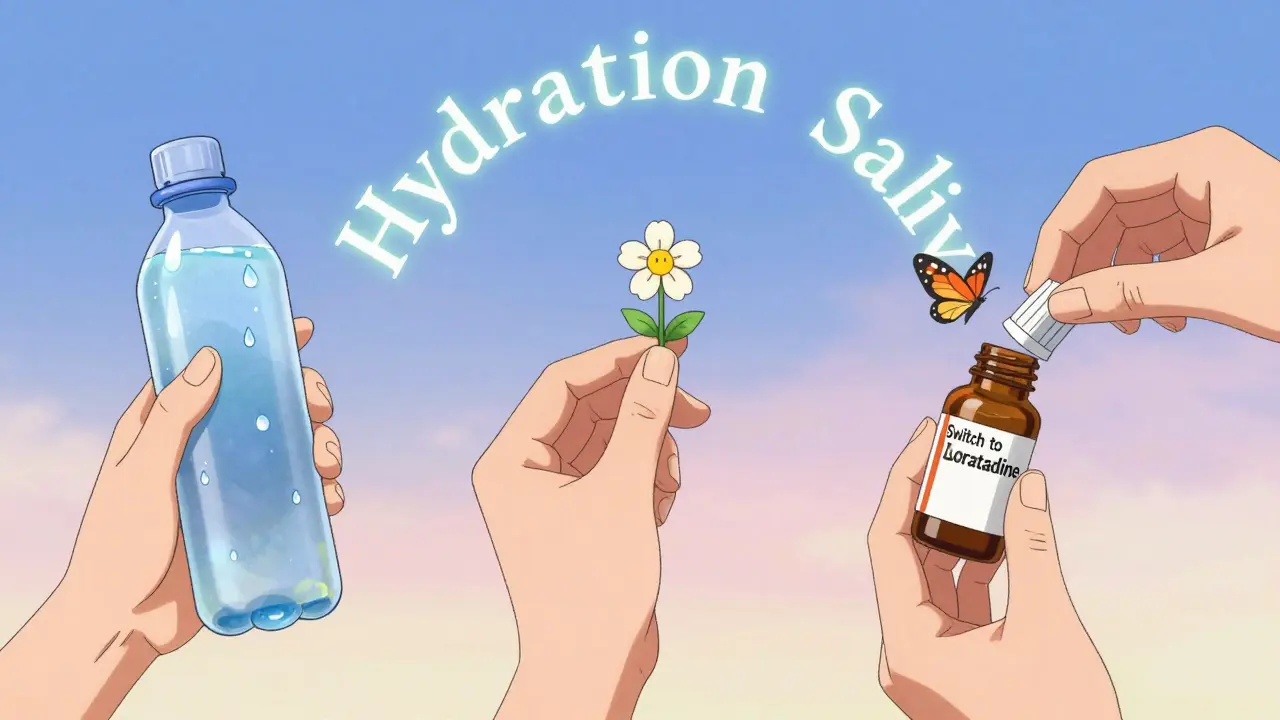
What You Can Do Today
You don’t need to wait for a doctor’s appointment to start protecting your mouth. Here’s what to do right now:
- Drink water throughout the day-small sips, not gulps. Avoid sugary drinks and alcohol.
- Chew sugar-free gum with xylitol. It stimulates saliva naturally.
- Use a humidifier in your bedroom at night.
- Switch from alcohol-based mouthwash to alcohol-free formulas.
- Stop smoking. It makes dry mouth worse and increases cancer risk.
- Keep a log: note when dry mouth is worst, what you took, and how bad it felt. This helps your doctor spot patterns.
And if you’re on five or more medications? That’s a red flag. Ask your pharmacist for a medication review. Pharmacists are trained to spot drug interactions and side effects like dry mouth. Many pharmacies now offer free reviews-no appointment needed.
What’s Changing in 2026?
The field is evolving fast. In April 2023, the FDA approved cevimeline (Evoxac) specifically for medication-induced dry mouth. New research from the National Institutes of Health is focused on developing non-anticholinergic alternatives for bladder and depression drugs. By 2027, the American Dental Association predicts all new medications will be required to include dry mouth risk assessments on their labels.
Insurance coverage is still a barrier. Only 43% of dental plans in Australia and the U.S. cover prescription saliva stimulants. But with more evidence linking dry mouth to dental emergencies-and rising healthcare costs-change is coming. Health systems are now piloting pharmacist-dentist collaboration programs. Early results show a 38% drop in dental complications among patients in these programs.
This isn’t about "just drinking more water." It’s about recognizing a hidden health risk that’s silently damaging teeth, changing diets, and lowering quality of life for millions. If you’re on medication and your mouth feels dry more often than not-you’re not alone. And you don’t have to live with it.
Can dry mouth from medication be reversed?
Yes, in many cases. If the medication is stopped or switched to a lower-risk alternative, saliva production often returns to normal within weeks. For those who can’t stop the drug, treatments like pilocarpine or cevimeline can restore up to 70% of saliva flow. Even without changing medication, consistent use of oral moisturizers and hydration can prevent further damage and improve comfort.
Is dry mouth a sign of something more serious?
Not always, but it can be. While most cases are caused by medications, dry mouth can also signal diabetes, Sjögren’s syndrome, or nerve damage. If you’re not on any medications and suddenly develop dry mouth, or if it’s accompanied by eye dryness, joint pain, or fatigue, see your doctor. A simple blood test can rule out autoimmune conditions.
Do over-the-counter products really help?
They help with symptoms, but not the root cause. Products like Biotene, Xylimelts, and sugar-free lozenges provide temporary relief by moisturizing the mouth. They don’t increase saliva production. For long-term protection, combine them with prescription stimulants (if eligible) and dental care. They’re essential tools, but not cures.
Can I use mouthwash if I have dry mouth?
Only alcohol-free mouthwash. Alcohol dries out your mouth further and can irritate sensitive tissues. Look for products labeled "for dry mouth" or those containing xylitol or fluoride. Brands like ACT Dry Mouth Rinse or Colgate Hydrate are designed specifically for this condition.
Why does dry mouth get worse at night?
Saliva production naturally slows during sleep. If your glands are already damaged by medication, they produce almost nothing at night. This is why many people wake up with a parched mouth. Using a humidifier, drinking water before bed, and applying a thick moisturizing gel (like those from Biotene or Oralbalance) before sleeping can help.
If you’re taking multiple medications and notice dry mouth, don’t assume it’s just part of aging. Talk to your doctor. Talk to your dentist. Ask about alternatives. Use the right products. Your teeth, your comfort, and your health are worth it.