
Drug Recalls and Safety Alerts: How to Stay Informed About FDA Warnings
Drug Recall Checker
Enter your prescription drug name below to verify if it's currently recalled by the FDA. This tool uses simulated data for demonstration purposes.
Every year, hundreds of medications are pulled from shelves because of hidden dangers-contaminated pills, incorrect dosages, or rare but deadly side effects that only show up after thousands of people have taken them. These aren’t theoretical risks. In 2022, the FDA issued 127 drug recalls, up 17% from the year before. Many of these recalls happened because someone, somewhere, noticed something wrong-and reported it.
If you or someone you care about takes prescription meds, over-the-counter drugs, or even supplements, you need to know how to spot a safety alert before it affects you. It’s not about being paranoid. It’s about being informed. And the good news? The system works-if you know how to use it.
How Drug Recalls Actually Happen
Most drugs are approved based on clinical trials involving a few thousand people. But real life isn’t a trial. Millions take the same pill, with different health conditions, other medications, or genetic differences. That’s where problems show up.
The FDA doesn’t wait for disasters. It monitors reports of bad reactions through its MedWatch system, which collects over 1.3 million reports annually from doctors, pharmacists, and patients. When a pattern emerges-say, five people develop liver damage after taking the same generic blood pressure drug-the FDA investigates. If the risk is confirmed, they issue a Drug Safety Communication (DSC), the highest-priority alert.
These aren’t vague warnings. In May 2023, the FDA updated the Boxed Warning on all ADHD stimulants after data showed increased risk of heart problems in adults with pre-existing conditions. That’s the kind of alert that changes prescribing habits-and saves lives.
What You’ll See in a Safety Alert
Not all alerts are created equal. The FDA breaks them into three types:
- Drug Safety Communications (DSCs) - Urgent, high-risk issues. These get published on the FDA website, emailed to subscribers, and sometimes show up in news headlines.
- Drug Alerts and Statements - Less urgent, but still important. These might warn about manufacturing issues, like a batch with the wrong strength.
- Labeling Changes - Updates to the drug’s official说明书 (package insert). These are subtle but critical. A new warning about dizziness or interactions might be buried in fine print, but it’s legally required.
Here’s what to look for in any alert:
- The exact drug name (brand and generic)
- The specific risk (e.g., “increased risk of heart attack,” “contaminated with mold”)
- Who’s affected (e.g., “patients over 65,” “those taking blood thinners”)
- What to do next (e.g., “stop taking,” “call your doctor,” “return to pharmacy”)
Many alerts include a “Risk Evaluation and Mitigation Strategy” (REMS). That’s the FDA’s way of saying, “This drug is risky, but we’re not pulling it-so here’s how to use it safely.” REMS might mean mandatory training for prescribers or special patient monitoring.
How to Get Alerts Before They Hit the News
You don’t have to wait for a headline. The FDA gives you direct access to real-time alerts. Here’s how to set it up:
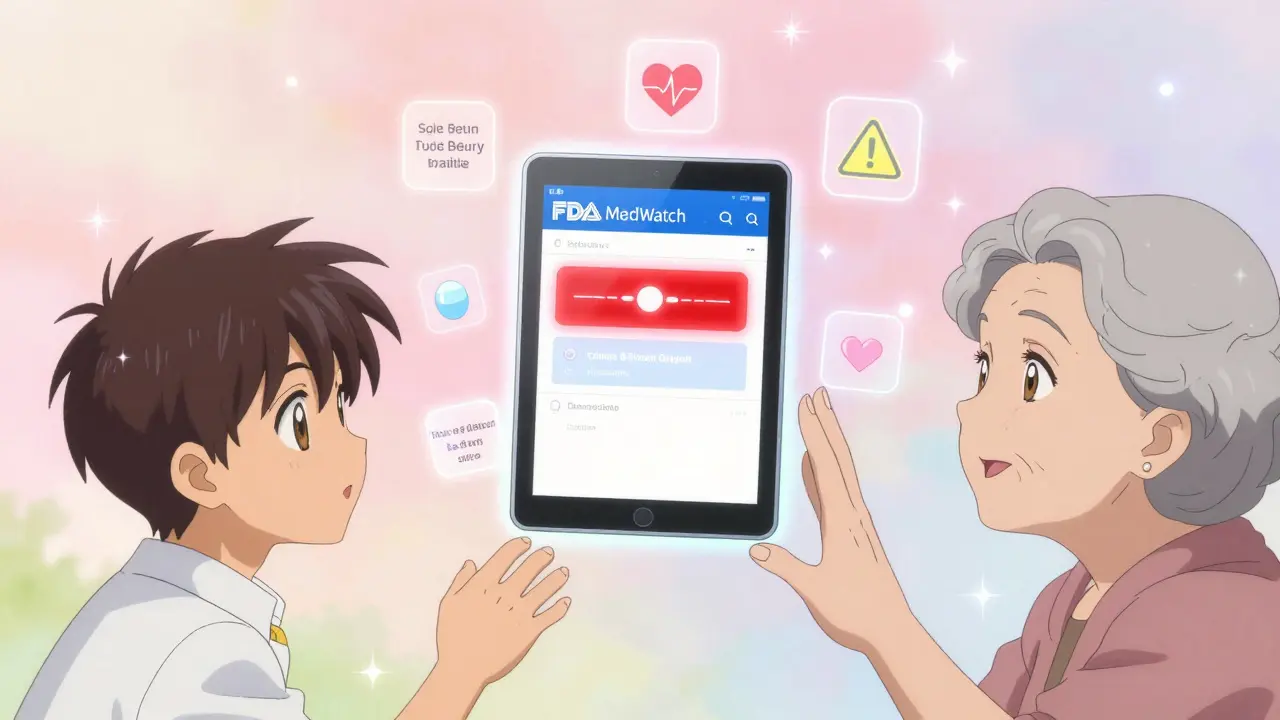
- Sign up for FDA Drug Safety Communications by email - Go to the FDA’s MedWatch page and subscribe to the DSC mailing list. As of 2023, over 450,000 people get these emails. You’ll get one or two a week-only the urgent ones.
- Download the MedWatch app - Available on iOS and Android, this lets you report adverse reactions directly from your phone. It also pushes critical alerts. Over 187,000 people have downloaded it since 2022.
- Check the FDA’s Drug Recalls page weekly - It’s updated daily, but checking once a week is enough. You can search by drug name, company, or recall reason.
- Ask your pharmacist to notify you - Most pharmacies get FDA alerts. Ask if they’ll call or text you if your medication is recalled or has a new warning.
Don’t rely on Google alerts or social media. Scammers often fake recall notices. Only trust official sources: FDA.gov, the MedWatch app, or your pharmacy.
What the FDA Doesn’t Cover (And How to Protect Yourself)
Here’s the uncomfortable truth: the FDA doesn’t regulate everything you take.
Dietary supplements? The FDA only steps in after someone gets hurt. In 2022, there were 2,750 adverse event reports for supplements-but only 12 formal safety alerts issued. That’s because supplements don’t need pre-market approval. If a weight-loss pill contains hidden stimulants or a joint supplement has heavy metals, you might not know until it’s too late.
What can you do?
- Look for third-party testing seals: USP, NSF, or ConsumerLab. These aren’t perfect, but they mean the product was independently checked.
- Search the FDA’s database for supplements with warnings. Type “supplement warning FDA” into a search engine and check the results.
- When in doubt, skip it. If a supplement promises “miracle results” or says it’s “natural and safe,” it’s probably not.
Also, remember: generics aren’t always identical. The FDA allows small variations in inactive ingredients. If you switch from one generic version of your pill to another and feel worse, talk to your doctor. It might not be your condition-it might be the filler.
What to Do If You Think a Drug Is Hurting You
If you experience something unusual after taking a medication-rash, dizziness, nausea, chest pain, strange behavior-don’t assume it’s “just side effects.”
Here’s what to do:
- Stop taking the drug if it’s serious (like trouble breathing or swelling).
- Call your doctor or go to urgent care.
- Report it to the FDA using MedWatch. You can do it online in under 10 minutes.
- Keep the pill bottle and packaging. The FDA may ask for it.
Over 21,000 consumer reports were submitted to MedWatch in 2022. Most came from people who thought, “Maybe this isn’t normal.” They were right.
Why Most People Miss These Alerts
A 2023 Medscape poll found that 68% of doctors ignore drug safety alerts because they get too many. That’s called “alert fatigue.” Hospitals have tried to fix this by sorting alerts into three levels: Critical, Important, and Informational. Only the Critical ones force action.
For patients, the problem is simpler: most people don’t know where to look. A Pew Research study found only 12% of U.S. adults could correctly explain how to report a bad reaction.
Don’t be one of them. Set up your alerts now. It takes five minutes. The cost? Nothing. The benefit? You might avoid a hospital visit-or worse.
What’s Changing in 2025
The FDA’s new AI system, launched in early 2023, scans over a billion patient records to spot safety signals 40% faster. It’s already flagged several hidden risks that human reviewers missed.
They’re also testing social media monitoring. If thousands of people on Reddit or TikTok start saying, “This new migraine drug made me hallucinate,” the FDA might catch it before it becomes a pattern.
But funding is tight. The FDA’s Office of Surveillance is $47 million short in 2024. That could delay new tools. Your participation matters more than ever.
Stay informed. Report what you see. And don’t wait for the news to tell you something’s wrong.

Sally Denham-Vaughan
Just signed up for the FDA email alerts last week after my mom had a bad reaction to a generic blood pressure med. Honestly? Should’ve done it years ago. Now I get them straight to my inbox and even forwarded one to my cousin who’s on that ADHD stimulant. Small move, big difference.
Bill Medley
Official sources only. No exceptions.
Richard Thomas
It’s fascinating how we’ve outsourced vigilance to institutions while believing we’re safe because they exist. The FDA doesn’t protect us-it amplifies our own awareness. The real system isn’t the database or the email list. It’s the moment someone says, ‘This doesn’t feel right,’ and chooses to act. That’s the only real safety net we’ve ever had. All the tech, all the algorithms, all the funding-it’s just scaffolding. The human instinct to question, to report, to care-that’s what keeps us alive.
Paul Ong
Set up the alerts today. Took 4 minutes. My pills are safe now. No more guessing. Just do it. Seriously.
Andy Heinlein
OMG I just realized I never checked my supplement bottle for USP seal 😳 I’ve been taking that ‘natural energy booster’ for 2 years… I’m gonna call my pharmacist right now. Also the FDA app is so easy to use like wow
Ann Romine
In Japan, pharmacists call you directly if there’s a recall. Here, you’re expected to hunt for it. The gap in care is staggering. We treat health like a hobby, not a right.
Todd Nickel
The statistical basis for drug safety monitoring is fundamentally flawed. Clinical trials are underpowered for rare adverse events, and passive reporting systems like MedWatch suffer from severe underreporting bias-studies suggest only 1-10% of adverse reactions are reported. The FDA’s AI initiative is promising, but it’s still reactive. What we need is a national pharmacovigilance network with mandatory reporting from EHRs, real-time signal detection, and patient-reported outcomes integrated at the point of care. Until then, we’re all gambling with our physiology, hoping the algorithm catches the outlier before it becomes a fatality.
Phoebe McKenzie
Of course the FDA is slow. They’re bought off by Big Pharma. You think they’d recall a drug that kills people? Nah. They wait until the lawsuits start rolling in. And those ‘third-party seals’? USP is funded by supplement companies. You’re being manipulated. The only safe drug is the one you never take. And don’t even get me started on the FDA’s ‘AI system’-it’s just more surveillance. They’re watching you, not protecting you.
gerard najera
Report it. Always.
Stephen Gikuma
Why does the FDA even exist if they’re letting foreign labs make our pills? China’s running the show. They’re poisoning us slowly and calling it ‘cost efficiency.’ And now they want us to trust an app? This is how they control us. Wake up. The real recall is the one they won’t admit: our government is compromised.
Bobby Collins
I saw a TikTok video that said the FDA is hiding the truth about antidepressants and that they cause brain damage after 6 months. I think they’re right. Why else would they make you sign a waiver? I’m done with all meds. I’m going herbal. No more poison.
Layla Anna
My grandma takes 8 different pills and never checks anything… I showed her the FDA app and she cried 😭 she said she didn’t know she could report things. Now she sends me screenshots every time she gets a new med. We’re doing better now. 🤍