
Dissolution Testing: How the FDA Ensures Generic Drug Quality

Why dissolution testing matters more than you think
If you take a generic pill, you expect it to work just like the brand-name version. But how does the FDA make sure it actually does? The answer isn’t in clinical trials on thousands of people. It’s in a lab, with a machine spinning a basket in a beaker of liquid. That’s dissolution testing - a quiet, critical process that keeps generic drugs safe and effective without needing to test them on humans every time.
What dissolution testing actually is
Dissolution testing measures how quickly a drug releases its active ingredient into a liquid that mimics the human digestive system. Think of it like watching a sugar cube dissolve in tea. But instead of sugar, it’s the medicine - and instead of tea, it’s a pH-controlled buffer at 37°C, the same temperature as your body.
The FDA requires this test for nearly all oral solid pills, capsules, and suspensions. It doesn’t apply to liquids you swallow or creams you rub on your skin - those are already dissolved or absorbed differently. For tablets and capsules, though, this test is non-negotiable. If the drug doesn’t dissolve properly, it won’t be absorbed. And if it’s not absorbed, it won’t work.
The five pillars of FDA dissolution requirements
When a company applies to sell a generic drug, they must submit five types of dissolution data:
- Solubility of the active ingredient - Is it water-soluble? Does it need special conditions to break down?
- Test method validation - What machine? What speed? What liquid? How much? The FDA specifies USP Apparatus 1 or 2, rotation speeds between 50-100 rpm, and volumes of 500-900 mL. The pH must match stomach or intestine conditions.
- Method robustness - What happens if the temperature changes by 1°C? Or the rotation speed drops by 5 rpm? The method must still give consistent results.
- Accuracy of measurement - Can the lab accurately measure how much drug is in the liquid? This is often done with UV spectrophotometry or HPLC.
- Discriminatory power - Can the test tell the difference between a good formulation and a bad one? This is especially important for low-solubility drugs or slow-release pills.

How the FDA sets the bar: 80% in 45 minutes
For most immediate-release pills, the standard is simple: at least 80% of the drug must dissolve within 45 minutes. But that’s not a one-size-fits-all rule.
For highly soluble, highly absorbable drugs (BCS Class I), the FDA allows a simpler test: one point at 30 minutes using 900 mL of 0.1N HCl. If the generic matches the brand-name drug’s release at that single point, it can skip human bioequivalence studies entirely. That’s a big deal - it saves time, money, and avoids putting patients through unnecessary trials.
For slow-release pills, things get complex. The test runs at three different pH levels: 1.2 (stomach), 4.5 (upper intestine), and 6.8 (lower intestine). There’s also alcohol challenge testing - what happens if someone takes the pill with a beer? Some pills can release all their drug at once if alcohol is present, causing dangerous spikes in blood levels. The FDA requires manufacturers to test for this risk.
The f2 factor: How similarity is measured
It’s not enough for a generic drug to dissolve 80% in 45 minutes. It has to dissolve at the same rate as the brand-name drug. That’s where the f2 similarity factor comes in.
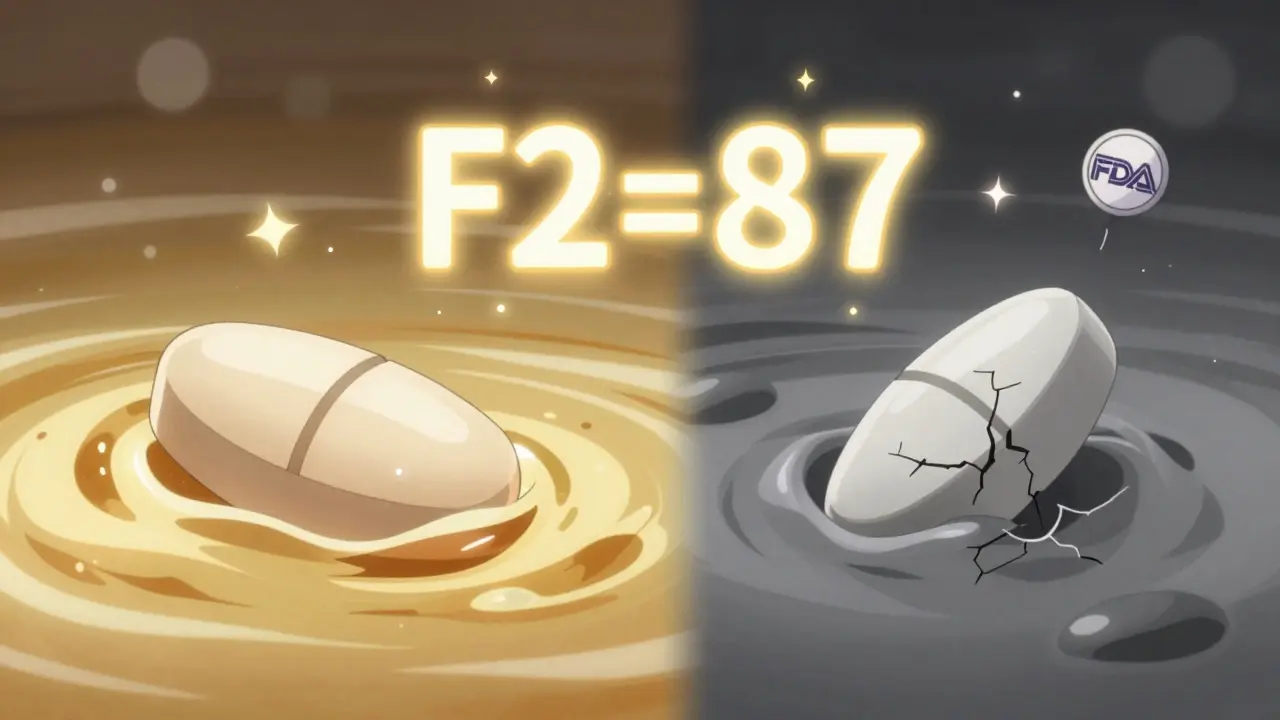
The FDA calculates f2 by comparing the dissolution profiles of the generic and the brand-name drug over time - usually at 10, 20, 30, 45, and 60 minutes. If the f2 value is 50 or higher, the profiles are considered statistically similar. An f2 of 100 means they’re identical. Anything below 50? The application gets rejected.
This isn’t just math. It’s the difference between a drug that works and one that doesn’t. A study of 200 approved generics showed that those with f2 scores above 60 had near-identical blood levels in patients. Those below 50? Even if they met the 80% rule, their performance varied too much.
Why this matters more for generics than new drugs
New drug companies spend years and billions on clinical trials to prove their product works. Generic companies don’t. They rely on the FDA’s trust in dissolution testing as a stand-in for human data.
This is the core of the Abbreviated New Drug Application (ANDA) process. No need to repeat the clinical trials. Just prove your pill dissolves like the original. That’s why the FDA treats dissolution data as the most important part of an ANDA submission. A single flawed dissolution method can delay approval for years.
Even small changes - switching a supplier, changing a tablet coating, moving production to a new factory - require new dissolution testing. The FDA’s SUPAC-IR guidelines demand that manufacturers prove no change in dissolution profile after any manufacturing tweak. If the drug releases faster or slower after the change, the product can’t be sold without re-approval.
Real-world challenges: The 6-month grind
Developing a dissolution method isn’t quick. For complex drugs - especially those with poor solubility or modified-release coatings - it can take 6 to 12 months. Labs run hundreds of tests, adjusting pH, surfactants, agitation speed, and temperature to find the right conditions.
The FDA maintains a public Dissolution Methods Database with over 2,800 recommended methods. Manufacturers use this as a starting point. But even then, they often need to customize. One company spent 14 months trying to find a method that could distinguish between two nearly identical extended-release formulations. Only after adding a surfactant to the medium did the test show a clear difference.
And the paperwork? A single ANDA submission can include 50 to 100 pages of dissolution development data. That’s just one part of the application - but it’s often the part that triggers the most questions from FDA reviewers.
What’s changing in 2026
The FDA is pushing toward more physiologically relevant testing. That means using fluids that better mimic real stomach and gut conditions - not just buffer solutions. There’s also growing interest in expanding biowaivers to BCS Class III drugs (high solubility, low permeability), which could cut approval times for hundreds of generics.
By 2025, an estimated 35% of generic approvals will use standardized dissolution methods to skip human trials - up from 25% in 2020. But the FDA’s message is clear: dissolution testing must be product-specific. No shortcuts. No blanket rules. Every drug gets its own test, tailored to how it behaves in the body.
Bottom line: Trust, but verify
You don’t need to know how dissolution testing works to take your generic pill. But you should know this: the FDA doesn’t rely on luck or trust. They use science - precise, repeatable, measurable science - to make sure every generic drug you take performs like the brand-name version. It’s not glamorous. It’s not flashy. But without it, the entire system of affordable medicines would collapse.
What is dissolution testing in generic drugs?
Dissolution testing is a lab procedure that measures how quickly a drug releases its active ingredient in a liquid that simulates the human digestive system. It’s used by the FDA to prove that a generic drug releases its medicine at the same rate and amount as the brand-name version, ensuring it will work the same way in the body.
Why doesn’t the FDA require human trials for every generic drug?
The FDA allows biowaivers for certain generics - especially those with high solubility and permeability (BCS Class I) - if their dissolution profile matches the brand-name drug exactly. Since dissolution rate strongly predicts how the drug behaves in the body, human trials become unnecessary. This saves time, money, and avoids exposing patients to experimental conditions.
What is the f2 similarity factor?
The f2 factor is a statistical tool the FDA uses to compare the dissolution profiles of a generic drug and its brand-name counterpart. It measures how closely the two release their active ingredients over time. An f2 value of 50 or higher means the profiles are similar enough to be considered bioequivalent. Below 50, the generic is rejected.
How does the FDA handle slow-release or extended-release generics?
For extended-release products, the FDA requires dissolution testing under multiple pH conditions (1.2, 4.5, and 6.8) to simulate different parts of the digestive tract. They also test for "dose dumping" - when alcohol or food causes the drug to release all at once. Manufacturers must prove their formulation remains stable under these conditions to get approval.
Can a generic drug be approved even if its dissolution profile differs from the brand?
Yes - but only in rare cases. If a generic shows a different dissolution profile but still proves bioequivalence in human studies, the FDA may set unique dissolution specifications for that product. This usually happens with low-solubility drugs where standard methods don’t capture real-world performance. The FDA still requires strong scientific justification.
What happens if a generic drug manufacturer changes its formula?
Any change - even switching suppliers of an inactive ingredient - triggers new dissolution testing under FDA’s SUPAC-IR guidelines. The manufacturer must prove the new version releases the drug at the same rate as the original. If the profile changes, the FDA may require re-approval or even pull the product from the market.




Melissa Cogswell
Dissolution testing is the unsung hero of generic drugs. I work in pharma QA and can tell you, getting that f2 score right takes months of trial and error. One tiny change in the coating and suddenly your 80% in 45 minutes becomes 65% - and boom, rejection letter. It’s not magic, it’s meticulous science.
Most people think generics are just cheap copies. But the lab work behind them? It’s often more rigorous than the original brand’s early development. The FDA doesn’t cut corners - they just don’t need to repeat human trials when the dissolution profile proves bioequivalence.
Diana Dougan
So you’re telling me the FDA lets a robot spin a basket in a beaker decide if my blood pressure med works? Cool. Next they’ll let a chatbot prescribe my insulin. 😏
Also, ‘f2 factor’? Sounds like a rejected Marvel villain. Can we just do actual human trials? I don’t trust machines to know how my body feels after 3 years of generic metformin.
Bobbi Van Riet
I’ve been on a lot of generics over the years - antidepressants, thyroid meds, statins - and honestly, I’ve never noticed a difference. But reading this made me realize how much work goes into making sure that consistency exists. It’s not just about cost. It’s about reliability.
For example, I had a bad reaction once to a generic version of my blood thinner because the manufacturer switched binders without updating the dissolution profile. Took me months to figure out it wasn’t my body - it was the pill. That’s why these standards matter. Not because we’re paranoid, but because we’ve been burned before.
The FDA’s SUPAC guidelines? They’re not overkill. They’re protection. And the fact that they maintain a public database of methods? That’s transparency most industries would kill for.
Also, the alcohol challenge test? Genius. I’ve seen people take extended-release pills with a beer and wonder why they felt ‘overdosed.’ It’s not them. It’s bad formulation. Thank god someone’s testing for that.
Holly Robin
THIS IS A COVER-UP. Dissolution testing is a scam. Big Pharma and the FDA are in bed together. They don’t want you to know that generics are often made in the same factories as brand names - but under different labels. They just tweak the coating slightly and call it ‘bioequivalent.’
Remember when the FDA approved that generic Adderall and people started having seizures? They blamed ‘individual metabolism.’ But the dissolution curve was off by 8%. They hid it.
And don’t get me started on the ‘f2 factor.’ That’s not science - it’s math magic. You can manipulate the sampling points. They pick the times that make the curve look good.
They’re selling you poison and calling it ‘affordable.’ Wake up. This isn’t regulation. It’s corporate theater. 🚩
Also, why do they use USP Apparatus 1 and 2? Because they’re cheap. Real labs use more advanced tech. But the FDA won’t fund it. Because they’re bought.
Shubham Dixit
India produces over 60% of the world’s generic drugs. And yet, you Americans act like dissolution testing is some new, mysterious FDA invention. We’ve been doing this since the 1980s. Our manufacturers don’t wait for FDA to tell them how to test - they do it better, faster, cheaper.
Our labs run 500+ dissolution runs per batch. We test at 1.2, 4.5, 6.8, and even 7.5 pH to simulate Indian gut conditions. We don’t just match the brand - we outperform it.
And yes, we use surfactants. Yes, we tweak viscosity. Yes, we know how to make slow-release work in hot, humid climates. You think your FDA is the only one who cares about quality? We care more - because our reputation is on the line every day.
So stop acting like you invented generic drug safety. We built this system. You just licensed it.
KATHRYN JOHNSON
It is imperative to underscore that dissolution testing is not a substitute for bioequivalence - it is the primary evidentiary pillar for bioequivalence in the context of oral solid dosage forms. The statistical rigor of the f2 metric, when applied under validated conditions, provides a reproducible, objective benchmark that precludes the necessity for human trials in a majority of cases. This is not an exception - it is the scientific standard.
Any deviation from this protocol constitutes a regulatory breach. The FDA’s adherence to USP methodologies is not arbitrary - it is codified, peer-reviewed, and globally harmonized. To dismiss it is to reject evidence-based medicine.
Sidhanth SY
Interesting read. I’ve worked in generic manufacturing in India, and I can say the pressure to pass dissolution tests is insane. One lab I worked at spent 18 months just optimizing a single extended-release tablet.
But here’s the thing - the system works. We had a client who switched from one supplier to another, and the new version failed dissolution at 30 minutes. They thought it was a fluke. Turned out the new binder absorbed moisture differently. Small change. Big impact.
It’s not sexy, but this is how real medicine gets made. No hype. No ads. Just people in white coats running tests while the rest of us scroll TikTok.
Also, the f2 thing? Yeah, it’s math. But math that saves lives. If your pill doesn’t dissolve right, you’re not getting the drug. Simple as that.
Yanaton Whittaker
AMERICA STILL LEADS THE WORLD IN MEDICAL INNOVATION 😎
Other countries make generics. But only the FDA has the guts to say ‘nope, that’s not good enough’ and make them redo it. We don’t cut corners. We don’t rush. We make sure your grandma’s blood pressure pill works - even if it takes 14 months and 300 test runs.
Shoutout to the FDA scientists who don’t get paid enough. You’re the real MVPs 🇺🇸💪
Donna Fleetwood
Reading this made me feel so much better about my meds. I used to worry that generics were ‘lesser.’ But now I get it - they’re not cheaper because they’re worse. They’re cheaper because we stopped testing on people.
It’s science doing the heavy lifting so we don’t have to. And honestly? That’s beautiful.
Thanks for explaining it so clearly. I’m gonna stop stressing and just take my pills. 😊
Blair Kelly
Let me get this straight - the FDA lets a machine spin a basket in a beaker decide if my life-saving drug is safe, but I can’t buy a vape pen without a 3-month waiting period?
This is a joke. A bureaucratic farce. They’ll spend $2 million to test dissolution for a $0.10 pill, but won’t let a diabetic buy insulin without a prescription written in triplicate.
There’s a word for this hypocrisy. And it starts with ‘C’ and ends with ‘ORRUPTION.’
Lily Steele
My dad’s on a generic statin. He used to panic every time the pill looked different. Now he just smiles and says, ‘If it’s FDA-approved, it’s good.’
Thanks for making me understand why that’s actually true. No drama. No fear. Just science.
Gaurav Meena
As someone who grew up in a village where medicine was scarce, I never thought I’d live to see generic drugs this reliable. In India, we fight for access - but here in the US, you fight for trust.
This post reminded me that science doesn’t care about borders. A dissolution curve in Delhi is the same as one in Boston.
Thanks for showing the quiet heroes behind every pill. 🙏
And yes, the f2 factor? It’s the quiet handshake between science and safety.
Jodi Olson
What is quality if not consistency? What is safety if not predictability?
The dissolution test is not about matching a brand name. It is about matching a biological expectation. The body does not care who manufactured the pill. It only cares whether the molecule arrives when and how it should.
This is not regulation. This is physics. This is chemistry. This is medicine stripped of marketing, of profit, of nationalism - reduced to the pure, silent, measurable truth of a molecule dissolving in water at 37 degrees.
That is the foundation. Everything else is noise.