
Barrett’s Esophagus: Understanding Dysplasia Risk and Effective Ablation Options

Barrett’s esophagus isn’t something you hear about often - until it affects you or someone close. It starts quietly, often as a side effect of long-term acid reflux. But what seems like a nuisance can turn into a serious threat: the only known path to esophageal adenocarcinoma, a cancer with a grim 20% five-year survival rate when caught late. The good news? If caught early and managed right, survival jumps to 80-90%. The key is knowing your risk, understanding what dysplasia means, and choosing the right treatment before it’s too late.
What Exactly Is Barrett’s Esophagus?
Barrett’s esophagus happens when the normal lining of your esophagus - the tube connecting your throat to your stomach - gets replaced by tissue that looks more like the lining of your intestine. This change, called metaplasia, is your body’s attempt to protect itself from constant stomach acid. It’s not cancer. But it’s a warning sign. About 5.6% of U.S. adults have it, and most don’t even know they have it until an endoscopy for chronic heartburn reveals it.
It’s not just about having acid reflux. You need to have symptoms at least once a week for five years or more. Men over 50, especially white men, are at highest risk. Obesity, especially belly fat, smoking, and a family history of Barrett’s or esophageal cancer all pile on the risk. Surprisingly, alcohol doesn’t raise your risk. Even Helicobacter pylori, the bacteria that causes ulcers, might actually lower your risk by reducing stomach acid production.
When Does Barrett’s Become Dangerous?
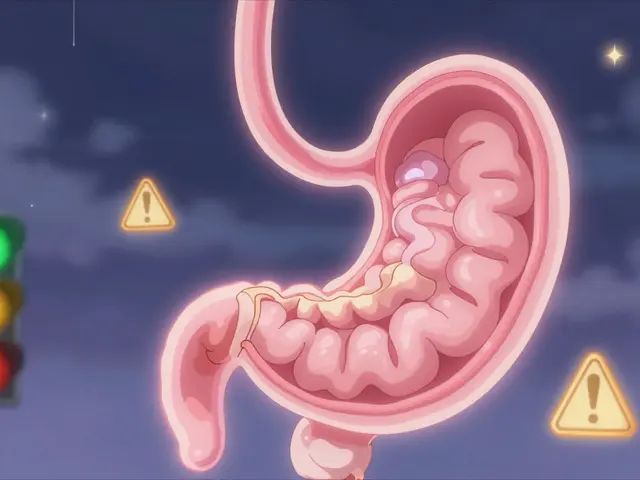
The real danger isn’t Barrett’s itself - it’s what it can turn into: dysplasia. Dysplasia means the cells are starting to look abnormal. Think of it like a traffic light: green (no dysplasia), yellow (low-grade dysplasia), red (high-grade dysplasia).
Low-grade dysplasia (LGD) means a few cells are off. It’s not cancer, but it raises your risk fivefold. High-grade dysplasia (HGD) is much more serious - it’s considered the final step before cancer. At this stage, your risk of developing esophageal adenocarcinoma jumps to 23-40% per year. That’s not a small number. For context, non-dysplastic Barrett’s only carries a 0.2-0.5% annual risk.
Length matters too. If your Barrett’s segment is longer than 3 centimeters, your risk goes up. If it’s over 10 cm, your risk is over 10 times higher than someone with short-segment Barrett’s. And if your acid reflux keeps coming back despite taking proton pump inhibitors (PPIs), your cells keep getting damaged - and your risk climbs again.
Ablation: The Game-Changer for Dysplasia
If you’re diagnosed with dysplasia, especially high-grade, your doctor will almost certainly recommend ablation - destroying the abnormal tissue before it turns cancerous. This isn’t surgery. It’s done through an endoscope, a thin tube with a camera, while you’re sedated. The goal? Erase the abnormal cells and let healthy tissue grow back.
Radiofrequency ablation (RFA) is the gold standard. It uses controlled heat to burn off the abnormal lining. The HALO360 system treats the whole circumference of the esophagus, while HALO90 targets visible spots. Studies show RFA clears dysplasia in nearly 88% of cases and removes the abnormal intestinal tissue in 77% after one year. Most people need two to three sessions, spaced a few months apart.
Cryoablation is the rising alternative. Instead of heat, it uses freezing - nitrous oxide cooled to -85°C - to destroy the tissue. It’s especially useful if you’ve had strictures (narrowing) before, because it’s gentler on the tissue. One study showed 82% success in erasing dysplasia. It’s also less likely to cause strictures than RFA, though it might need more sessions.
Photodynamic therapy (PDT) used to be common, but it’s fading fast. It requires a light-sensitive drug and weeks of avoiding sunlight. It works, but 17% of patients develop strictures, and skin sensitivity is a real problem. Endoscopic mucosal resection (EMR) is used for visible lumps or bumps - it’s like peeling off a patch of abnormal skin. It’s very effective for small lesions, but carries a small risk of bleeding or tearing the esophagus.

RFA vs. Cryoablation: What’s Better?
Here’s how they stack up:
| Method | Dysplasia Eradication Rate | Intestinal Metaplasia Eradication | Stricture Risk | Key Advantages | Key Drawbacks |
|---|---|---|---|---|---|
| Radiofrequency Ablation (RFA) | 87.9% | 77.4% | 6.2% | High success rate, fast healing, widely studied | Higher stricture risk, needs multiple sessions |
| Cryoablation | 82% | 65.2% | 2.8% | Safer for prior strictures, less pain, no heat damage | May need more sessions, slightly lower metaplasia clearance |
| Photodynamic Therapy (PDT) | 77% | Not routinely measured | 17% | Effective for large areas | Severe photosensitivity, high stricture rate, outdated |
| EMR (for visible lesions) | 93% (for resected lesions) | N/A | 1-2% | Removes visible nodules, provides tissue for biopsy | Risk of bleeding, perforation, not for diffuse disease |
Cost-wise, RFA averages $12,450 per session, cryoablation $9,850. But RFA needs fewer repeat treatments, so over five years, the total cost ends up being nearly the same. Insurance usually covers both if you have confirmed dysplasia.
Who Should Get Ablation - and Who Shouldn’t?
Guidelines are clear: if you have confirmed low-grade or high-grade dysplasia, ablation is recommended. The American College of Gastroenterology gives this a top-level 1A recommendation - the strongest possible. Studies show ablation cuts the risk of cancer by 90% compared to just watching and waiting.
But here’s the catch: not every diagnosis is accurate. Pathologists disagree on low-grade dysplasia up to 45% of the time. Community labs miss the signs more often than top university centers. That’s why experts recommend getting your biopsy reviewed by a GI pathologist who specializes in Barrett’s. If you’re told you have LGD, ask: “Can this be confirmed by an expert?”
And don’t get ablation if you don’t have dysplasia. About 25-30% of people with non-dysplastic Barrett’s get unnecessary treatment. That’s risky and expensive. Surveillance - regular endoscopies every 2-5 years - is the right path if your tissue is truly normal or just metaplastic.

What to Expect After Treatment
Most people feel fine within a day or two. You’ll have mild chest discomfort and maybe a sore throat. You’ll need to stick to soft foods for a week and avoid alcohol and spicy foods.
The biggest complication? Strictures. About 6% of RFA patients and 3% of cryoablation patients develop narrowing in the esophagus. If it happens, you’ll need dilation - a simple procedure where a balloon or tube gently stretches the area. Some patients need multiple dilations. One Reddit user shared: “The dilation hurt more than the Barrett’s ever did.”
But many report life-changing results. One patient on a support forum said: “My chronic cough from reflux vanished after cryoablation. I haven’t needed antacids in two years.”
What’s Next for Barrett’s Treatment?
The field is moving fast. New devices like the Barrx iCAP cryoablation system now monitor temperature in real time, making treatments safer. The upcoming HALO460 RFA system will treat longer segments more effectively.
Biggest breakthrough? Combining RFA with high-dose PPIs (40mg esomeprazole twice daily). The 2023 CHEERS trial showed this combo cuts recurrence risk to just 8.3% after three years - less than half the rate of standard doses.
Future tools include AI that spots dysplasia during endoscopy with 94% accuracy - better than most human endoscopists. And blood or tissue tests for biomarkers like TFF3 methylation might soon tell us who truly needs treatment - and who doesn’t. This could cut unnecessary procedures by 30%.
Bottom Line: Know Your Risk, Act Early
Barrett’s esophagus isn’t a death sentence. It’s a manageable condition - if you catch it in time. If you’ve had heartburn for over five years, especially if you’re a man over 50, overweight, or a smoker, talk to your doctor about an endoscopy. Don’t wait for symptoms to worsen.
If you’re diagnosed with dysplasia, don’t panic. Ablation works. RFA is the most proven option. Cryoablation is a strong alternative, especially if you’ve had complications before. Get your biopsy reviewed by an expert. Ask about the combination of ablation and high-dose PPIs. And don’t accept treatment if you don’t have dysplasia - surveillance is safer and just as effective.
The goal isn’t just to avoid cancer. It’s to live without constant reflux, without fear, without endless pills. That’s possible - and it starts with knowing your risk and choosing the right next step.
Can Barrett’s esophagus go away on its own?
Rarely. Without treatment, the abnormal tissue usually stays or gets worse. In a small number of cases, especially with aggressive acid suppression, the tissue may revert to normal - but this is unpredictable. Ablation is the only reliable way to remove it.
Do I need to keep getting endoscopies after ablation?
Yes. Even after successful ablation, you need regular follow-up endoscopies - usually once a year for the first few years, then every 2-3 years if everything stays clear. The esophagus can develop new abnormal areas, and cancer can still appear, though the risk is dramatically lowered.
Is cryoablation better than RFA for everyone?
Not necessarily. RFA has higher success rates in clearing the abnormal tissue and is the most studied option. Cryoablation is safer for people who’ve had strictures before or have very thin esophageal tissue. Your doctor will choose based on your history, the extent of your Barrett’s, and your risk factors.
Can I stop taking PPIs after ablation?
No. Even after successful ablation, you must continue taking proton pump inhibitors (PPIs) long-term. This prevents acid from damaging the new tissue and reduces the chance of Barrett’s returning. High-dose PPIs (40mg esomeprazole twice daily) are now recommended as part of standard care.
How do I know if my dysplasia diagnosis is accurate?
Ask for a second opinion from a GI pathologist who specializes in Barrett’s esophagus. Community pathologists agree on low-grade dysplasia only about 55% of the time. Experts at major medical centers have much higher accuracy. Getting your slides reviewed by one of these specialists can prevent unnecessary treatment - or missed cancer.
Are there any lifestyle changes that help after ablation?
Absolutely. Quit smoking - it doubles your cancer risk. Lose weight, especially around your belly. Avoid large meals, late-night eating, and trigger foods like caffeine, chocolate, and fatty foods. Elevate your head while sleeping. These steps reduce acid exposure and help the esophagus heal.
Is ablation covered by insurance?
Yes, if you have confirmed dysplasia. Medicare and most private insurers cover RFA and cryoablation for low-grade or high-grade dysplasia. Coverage for non-dysplastic Barrett’s is not approved. Always check with your provider and get pre-authorization if required.
What if I can’t afford ablation?
Cost shouldn’t be a barrier to care. Many academic centers offer financial assistance programs. Some manufacturers provide patient support for device costs. If you’re uninsured, ask about clinical trials - many are recruiting and cover all treatment costs. Delaying treatment because of cost increases your cancer risk significantly.

Jane Wei
I had RFA last year and honestly? My heartburn vanished. No more midnight antacids. Life’s weird like that - you think reflux is just part of being 52, then boom, one procedure and you sleep like a baby.
Martin Spedding
Barrett’s is just the latest corporate-gut-industry scam. They sell you fear, then charge $12k to burn your esophagus. I’ve had reflux since 2010. Still alive. Still not dead. Maybe just… stop eating pizza?
Raven C
One must consider the epistemological foundations of dysplasia diagnosis - the inter-subjective variance among pathologists is not merely statistical, but ontologically alarming. I have reviewed seven biopsy slides from three institutions; none concur. This is not medicine. It is ritualistic entropy dressed in white coats.
And yet - the PPIs? Non-negotiable. The literature is unequivocal. One does not abandon acid suppression post-ablation. To do so is to invite chaos into the mucosal architecture.
Naomi Lopez
Let’s be real - if you’re a white male over 50 with belly fat and you’ve been popping PPIs since your 40s, you’re already on the Barrett’s express train. The fact that this post doesn’t mention that 80% of cases are diagnosed incidentally during endoscopies for GERD is… telling. We’re all just walking time bombs with hiatal hernias.
And cryoablation? It’s not ‘better.’ It’s just what your GI doc pushes because they got a free demo unit. RFA has 15 years of data. Cryo? Two. Don’t get seduced by the word ‘gentler.’
Also - H. pylori lowers risk? That’s wild. Next you’ll tell me that drinking bleach prevents cancer.
Jessica Salgado
I was diagnosed with LGD last year. My doctor said ‘watch and wait.’ I cried in the parking lot. Then I got a second opinion - and the pathologist at Johns Hopkins said it was ‘indefinite for dysplasia.’ Turns out, my original lab misread it. I didn’t need ablation. I just needed someone who actually knew what they were looking at.
If you’re told you have LGD - don’t panic. Don’t rush. Get it reviewed by a Barrett’s specialist. Seriously. Ask for the pathologist’s name. Google them. If they haven’t published on Barrett’s, walk out.
This isn’t about fear. It’s about precision. And we’re not getting it right enough.
Patrick A. Ck. Trip
As a medical professional with a background in gastroenterology, I must emphasize that the data supporting ablation in confirmed dysplasia remains robust, despite the occasional diagnostic inconsistency.
It is imperative that patients, particularly those with long-standing GERD, engage in proactive surveillance, as early intervention remains the most effective means of preventing adenocarcinoma.
While cost and access remain challenges, the long-term economic burden of esophageal cancer far exceeds that of ablation.
Thank you for this well-researched piece.
Michael Whitaker
Actually, I think you're all missing the real issue here. The fact that you're even considering ablation means you've already lost the battle. The real solution is to stop treating the symptom - reflux - and start treating the cause: your diet, your stress, your lack of sleep, your refusal to acknowledge that your body is screaming for change.
Have you tried intermittent fasting? Or a plant-based, low-FODMAP, alkaline diet? No? Then you're just buying into the pharmaceutical-industrial complex. Ablation is just a Band-Aid on a hemorrhage.
And don't get me started on PPIs. They're causing osteoporosis, kidney failure, and vitamin B12 deficiency. You're trading one disease for three others.
Steven Lavoie
As someone who moved from the Philippines to the U.S. at 28, I never thought I’d be reading about Barrett’s - but my dad had it. He’s 74 now, no cancer, still takes PPIs, still eats adobo once a week. He didn’t get ablation. He just changed how he ate. Slower. Smaller bites. No lying down after dinner.
Maybe the real breakthrough isn’t in the tech - it’s in the quiet habits we ignore because we want a quick fix.
Also, H. pylori lowering risk? That’s actually kind of beautiful. Nature balances things, even when we don’t want it to.
Donna Packard
Thank you for writing this. I was terrified after my diagnosis. Now I feel like I actually understand what’s happening - and that I have options. Not just fear.